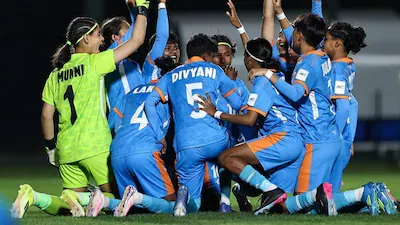
India’s U17 women’s football team scripted a historic breakthrough at the AFC U17 Women’s Asian Cup China 2026 after a commanding 4-0 victory over Lebanon women's national under-17 football team secured the nation’s first-ever qualification for the tournament’s knockout stage. Powered by a brilliant brace from Pritika Barman and additional goals from Alva Devi Senjam and Joya, the Young Tigresses also registered India’s first goals and first victory in the competition since 2005. The landmark achievement reflects the growing maturity of India’s women’s football ecosystem and signals the emergence of a promising generation capable of reshaping the country’s future on the continental stage.
India Achieves Historic Breakthrough in Asian Women’s Football
Indian football entered a new chapter on Friday as the country’s U17 women’s side secured a landmark qualification for the quarter-finals of the AFC U17 Women's Asian Cup China 2026.
The emphatic 4-0 victory against Lebanon women's national under-17 football team at the Suzhou Taihu Football Sports Centre marked the first time India progressed beyond the group stage of the tournament.
More significantly, the triumph ended a prolonged wait for success at this level, delivering India’s first victory and first goals in the AFC U17 Women’s Asian Cup since 2005. The result represents a major milestone not only for the squad but also for the broader development of women’s football across the country.
Pritika Barman Emerges as the Face of India’s Victory
The defining figure of India’s dominant performance was Pritika Barman, whose clinical finishing and attacking intelligence proved instrumental in dismantling Lebanon’s defensive structure.
Barman scored twice in a composed and technically refined display that highlighted the growing quality emerging from India’s youth football system. Her movement off the ball, ability to exploit spaces, and composure inside the penalty area gave India the attacking edge required to control the contest from the opening stages.
At a tournament where confidence and efficiency are critical, her performance symbolized the self-belief with which the Young Tigresses approached the decisive encounter.
Team Cohesion Reflects India’s Tactical Progress
While Barman’s contribution stood out, India’s victory was fundamentally rooted in collective discipline and tactical organization. Goals from Alva Devi Senjam and Joya further demonstrated the side’s attacking depth and growing football maturity.
India maintained control of possession for extended periods while executing structured pressing and intelligent transitional play. The team displayed greater composure under pressure than in previous editions of the competition, reflecting improvements in coaching methodology and player preparation.
Defensively, the Young Tigresses remained organized throughout the match, limiting Lebanon’s opportunities and ensuring complete control over the tempo of the game.
Such performances indicate that India’s youth football structure is gradually evolving toward a more technically and tactically competitive standard.
A Defining Moment for Indian Women’s Football
The significance of India’s quarter-final qualification extends far beyond a single tournament result. It reflects years of incremental investment in grassroots development, scouting networks, coaching education, and youth infrastructure within women’s football.
Historically, India has struggled to establish a consistent presence in elite continental competitions at the youth level. The breakthrough in China therefore represents a symbolic shift in expectations and ambition.
In global football, youth tournaments frequently serve as indicators of long-term structural progress. Nations that succeed at junior levels often build sustainable senior programs capable of competing internationally. India’s advancement suggests that the foundations for such progress may finally be taking shape.
Growing Institutional Support Begins Delivering Results
The emergence of India’s U17 women’s team also highlights the increasing strategic focus on women’s football within the country’s sporting ecosystem.
Over recent years, governing bodies and football institutions have intensified efforts to strengthen women’s participation through grassroots initiatives, academy development, and exposure to international competition. These measures are beginning to produce visible results on the continental stage.
From a broader business perspective, successful international performances can significantly enhance commercial interest in women’s football. Increased visibility often leads to stronger sponsorship engagement, improved media attention, and greater institutional investment — all essential factors for sustaining long-term growth.
India’s historic qualification may therefore become a catalyst for accelerated development within the women’s game.
Youth Development Emerging as India’s Competitive Blueprint
One of the most encouraging aspects of India’s campaign has been the evident emphasis on structured youth development. Rather than relying solely on isolated talent, the team has demonstrated collective understanding, tactical flexibility, and technical competence.
These attributes reflect a growing recognition within Indian football that sustainable international competitiveness must be built through long-term developmental planning. Exposure to high-level tournaments at an early age is critical for nurturing players capable of handling the physical and mental demands of elite football.
As Asian women’s football continues to evolve rapidly, countries investing seriously in youth systems are increasingly positioning themselves for future success. India’s progress at the U17 level suggests the nation may finally be aligning with that long-term model.
Quarter-Final Qualification Inspires a New Generation
The Young Tigresses’ achievement has already become one of the most significant moments in recent Indian football history. Beyond statistics and tournament progression, the victory offers inspiration for a new generation of female athletes across the country.
By reaching the knockout stage of the AFC U17 Women's Asian Cup China 2026, India has demonstrated that sustained planning, investment, and belief can translate into meaningful international success.
As the team prepares for the quarter-finals, expectations will naturally rise. Yet regardless of what follows, the emphatic victory over Lebanon has already established itself as a transformative milestone in the evolution of Indian women’s football — one that could shape the trajectory of the sport for years to come.
Comments