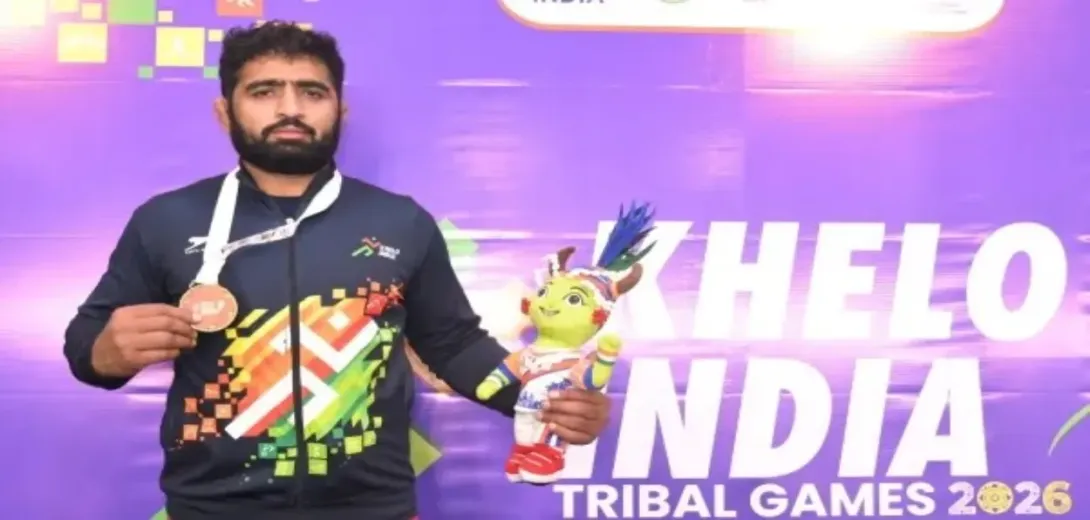
In a powerful testament to perseverance, 28-year-old wrestler Hamam Hussain from Jammu and Kashmir has captured his first national-level gold medal at the Khelo India Tribal Games held in Ambikapur. Competing in the men’s 79kg freestyle category, Hussain defeated Mohit Kumar of Himachal Pradesh, marking a breakthrough moment after more than a decade of dedication to wrestling. His journey to the podium reflects resilience shaped by economic hardship and personal sacrifice following the death of his father. Supported by his elder brother, who abandoned his own wrestling ambitions to sustain the family, Hussain’s victory highlights both determination and the growing importance of grassroots sports programs in India.
A Landmark Victory at the Khelo India Tribal Games
The gold medal victory of Hamam Hussain at the Khelo India Tribal Games represents a defining chapter in the wrestler’s long and demanding career.
Competing in the men’s 79kg freestyle division in Ambikapur, Hussain delivered a disciplined and confident performance in the final, overcoming Mohit Kumar of Himachal Pradesh to secure the top podium position. The victory marks the culmination of a 14-year commitment to the sport and establishes Hussain as a rising figure in India’s competitive wrestling circuit.
For many athletes participating in grassroots tournaments, such national-level competitions serve as a gateway to broader recognition and future opportunities.
A Life Defined by Determination
Born and raised in Jorawar village in Jammu, Hamam Hussain began wrestling at an early age, dedicating years to rigorous training despite limited resources. His path, however, was far from smooth.
Five years ago, the sudden death of his father placed significant financial pressure on the family. With limited sources of income, Hussain and his elder brother assumed responsibility for supporting the household.
To sustain daily expenses, the brothers turned to dairy work, selling milk from the buffaloes their father had left behind. The modest livelihood allowed the family to survive financially while Hussain continued to pursue his dream of becoming a competitive wrestler.
The Role of Family Sacrifice
Behind Hussain’s achievement lies a story of profound personal sacrifice. Recognizing his younger brother’s potential in wrestling, Hussain’s elder sibling made the difficult decision to abandon his own ambitions in the sport.
Instead, he dedicated himself to managing the family’s dairy work full time, ensuring that Hamam Hussain could continue training and competing without interruption.
This act of familial support illustrates a broader reality faced by many athletes in rural India, where sporting careers often depend on the collective efforts and sacrifices of family members.
Khelo India’s Role in Grassroots Talent Development
The Khelo India Tribal Games has emerged as a significant platform for identifying and nurturing athletic talent from underserved regions. The initiative forms part of India’s broader effort to strengthen grassroots sports infrastructure and provide competitive exposure to athletes from tribal and rural communities.
Through structured tournaments, training support, and national-level recognition, programs under the Khelo India umbrella aim to bridge the gap between local talent and elite competition.
For athletes like Hussain, participation in such events can open doors to institutional training facilities, government scholarships, and future representation at higher-level tournaments.
Economic Challenges in Grassroots Sports
Hussain’s journey also sheds light on the economic realities faced by aspiring athletes outside major urban centers. Limited access to training infrastructure, equipment, and financial support often forces athletes to balance demanding work schedules alongside rigorous training.
In many cases, sporting ambitions are sustained through personal resilience rather than institutional support. Stories such as Hussain’s underscore the importance of continued investment in grassroots development programs that can identify and nurture talent across the country.
From a broader perspective, strengthening the grassroots ecosystem not only enhances national sporting performance but also contributes to long-term economic growth through the development of professional sports industries.
A Symbol of Hope for Emerging Athletes
The triumph of Hamam Hussain in Ambikapur stands as a powerful reminder that determination and community support can overcome formidable obstacles.
His journey—from selling milk to help sustain his family to claiming a national gold medal at the Khelo India Tribal Games—offers inspiration to countless aspiring athletes across rural India.
As India continues to invest in grassroots sporting initiatives, stories like Hussain’s highlight the transformative potential of opportunity, perseverance, and family support in shaping the next generation of national champions.
Comments