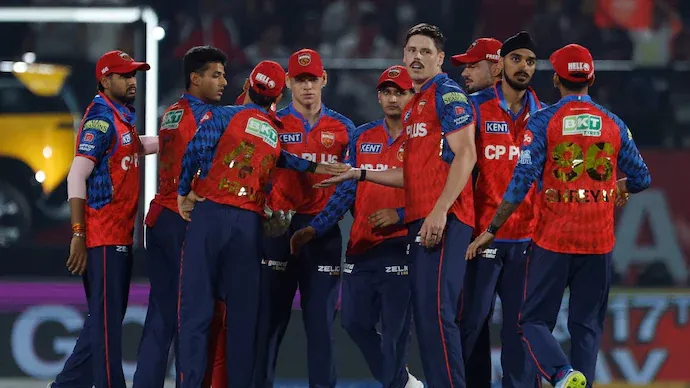
Punjab Kings endured a disappointing bowling performance in their IPL 2026 clash against Delhi Capitals at the HPCA Stadium in Dharamshala on May 11, as their attack lost control under breezy mountain conditions. Despite facing a vulnerable opposition batting lineup, Punjab Kings conceded 17 runs in wides along with a no-ball, allowing Delhi Capitals to regain stability in their innings. The lack of discipline highlighted persistent execution issues within the Punjab bowling unit, raising concerns about their tactical sharpness and composure in pressure situations. The match underlined how small errors in T20 cricket can significantly shift momentum and redefine outcomes.
Punjab Kings Fail to Capitalize in Favorable Conditions
The high-altitude conditions at the HPCA Stadium in Dharamshala were expected to assist disciplined bowling, with swing and movement typically amplified by the mountain breeze. However, Punjab Kings failed to exploit these conditions effectively against Delhi Capitals in a crucial IPL 2026 encounter.
Instead of applying sustained pressure on a struggling batting order, Punjab’s bowlers struggled to maintain control over line and length. The inconsistency allowed Delhi Capitals to escape difficult phases and gradually rebuild momentum in what had initially been a fragile innings.
What should have been a dominant bowling display turned into a fragmented performance marked by lapses in discipline and execution.
Extras Prove Costly in Critical Phase of the Match
A defining feature of the contest was Punjab Kings’ inability to control extras during key overs.
The team conceded 17 runs through wides and added a no-ball, a combination that significantly undermined their defensive efforts. In the context of T20 cricket, where margins are extremely narrow, such avoidable errors often carry disproportionate consequences.
For Punjab Kings, these additional runs not only inflated the opposition total but also disrupted bowling rhythm and fielding intensity. Each extra delivery provided Delhi Capitals with unplanned scoring opportunities, easing pressure at moments when wickets could have shifted the game decisively.
Delhi Capitals Regain Control Through Opportunistic Batting
Delhi Capitals effectively capitalized on Punjab’s lack of discipline, using the additional deliveries to stabilize their innings after early uncertainty.
Rather than collapsing under pressure, the Capitals adapted to the situation by rotating strike and taking advantage of loose deliveries. The flow of extras helped reduce scoreboard pressure and allowed their middle order to settle into a more comfortable rhythm.
In T20 cricket, such incremental advantages often prove decisive, particularly when a batting side is struggling for momentum. Delhi’s ability to convert Punjab’s errors into stability reflected a pragmatic approach to innings rebuilding.
Tactical and Execution Issues Under Scrutiny
The performance once again highlighted recurring concerns within the bowling structure of Punjab Kings.
Despite possessing a squad with considerable talent, the franchise has struggled throughout IPL 2026 to maintain consistency in execution during high-pressure situations. The Dharamshala match reinforced the perception that tactical plans are often undermined by on-field inaccuracies.
Cricket analysts frequently emphasize that in modern T20 leagues, success depends not only on strategy but also on precision and discipline. Punjab’s inability to consistently hit optimal lengths or maintain control under pressure continues to be a critical weakness.
Shreyas Iyer’s Leadership Faces Execution Challenge
Under the leadership of Shreyas Iyer, Punjab Kings have shown intent to adopt structured game plans and proactive strategies. However, implementation has remained inconsistent across matches.
While leadership can set tactical frameworks, execution ultimately determines outcomes on the field. In this encounter, even well-designed bowling strategies were diluted by repeated lapses in control and discipline.
The result underscores a broader challenge for the team: translating planning into sustained on-field performance, particularly in high-pressure environments like the IPL.
Fine Margins Define IPL Outcomes
The Dharamshala contest once again reinforced a core reality of the Indian Premier League: small errors produce large consequences.
In a format defined by rapid momentum shifts, even a handful of misdirected deliveries can reshape the trajectory of an entire innings. Punjab Kings’ concession of 17 wides and a no-ball may appear marginal in isolation, but collectively, they altered the competitive balance of the match.
For Delhi Capitals, the ability to remain composed and capitalize on opposition mistakes proved decisive. For Punjab, the same errors reinforced a troubling pattern of inconsistency that has characterized their season.
Conclusion: Discipline Remains Punjab Kings’ Core Challenge
As IPL 2026 progresses, the performance in Dharamshala will likely be viewed as part of a broader narrative for Punjab Kings—one defined by potential repeatedly undermined by execution lapses.
While the team continues to display flashes of capability, sustained success in franchise cricket demands precision, control, and composure under pressure. Until these elements are consistently aligned, Punjab’s campaign risks remaining vulnerable in tightly contested encounters.
For now, Delhi Capitals leave Dharamshala with a crucial advantage, while Punjab Kings are left confronting yet another reminder that in modern T20 cricket, discipline is often the ultimate match-winner.
Comments