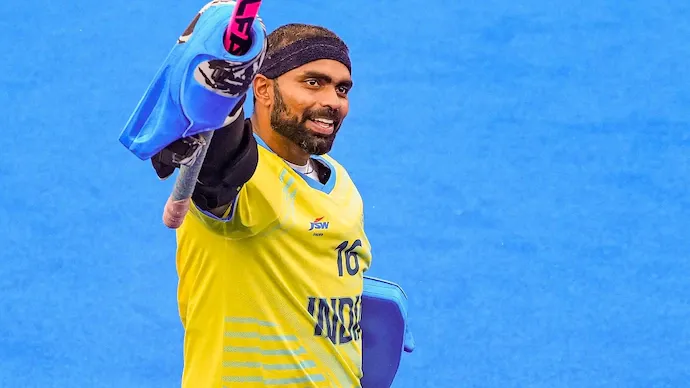
Former India goalkeeper PR Sreejesh has publicly questioned Hockey India’s administrative planning and developmental vision following his controversial departure from the junior men’s team setup. The decorated veteran criticized the lack of structural clarity surrounding the federation’s proposed development squad, pointing to the absence of a defined player base, competition schedule, and long-term roadmap. His remarks have triggered broader discussions about governance standards, athlete transition systems, and institutional transparency within Indian hockey. The controversy arrives at a crucial phase for the sport, as India attempts to build sustainable international success through stronger talent pipelines, modern sports management practices, and professionally structured development programs.
Sreejesh Raises Concerns Over Hockey India’s Operational Direction
Indian hockey has entered a fresh phase of introspection after former national goalkeeper PR Sreejesh openly questioned the administrative functioning of Hockey India following his departure from the junior men’s team structure.
Sreejesh, one of the most accomplished figures in modern Indian hockey, expressed dissatisfaction over what he described as a lack of planning and clarity surrounding the federation’s proposed development team initiative.
According to the former goalkeeper, the system lacked a clearly defined framework, with no finalized player pool, structured tournament pathway, or operational roadmap in place. His comments have intensified scrutiny around how Indian hockey intends to manage athlete development and long-term succession planning.
The issue has rapidly evolved beyond an individual disagreement, emerging instead as a broader conversation about governance quality and institutional accountability in Indian sport.
Development Team Model Faces Questions Over Structure
At the center of the controversy is Hockey India’s proposed development squad, which was reportedly envisioned as a transitional platform between junior and senior international hockey.
However, Sreejesh questioned whether the initiative had been adequately conceptualized before implementation. He suggested that without clearly defined objectives and competitive pathways, the model risked becoming administratively ineffective.
Sports development specialists have long emphasized that elite athlete progression requires carefully structured systems involving scouting networks, age-group continuity, international exposure, and regular competition calendars.
Without these foundational components, development programs often struggle to produce athletes capable of adapting to the tactical and physical demands of top-level international hockey.
Sreejesh’s criticism therefore reflects a larger concern regarding whether Indian hockey’s developmental ecosystem is evolving with sufficient strategic depth.
Timing of the Criticism Carries Wider Significance
The public nature of Sreejesh’s remarks is particularly significant given the timing. Indian hockey has experienced notable growth in recent years, driven by improved international performances, stronger commercial backing, and renewed public interest in the sport.
The revival of franchise-based hockey competitions and greater investment in sports infrastructure have also contributed to optimism surrounding the game’s future in India.
Against that backdrop, criticism from a player of Sreejesh’s stature has drawn widespread attention. His long-standing association with Indian hockey and his reputation as a respected senior figure have added credibility to concerns regarding communication gaps and administrative preparedness.
Analysts believe the controversy highlights the increasing expectations now placed on sports federations operating in a more professional and commercially visible environment.
Athlete Transition Systems Becoming Increasingly Critical
Modern international sport places growing importance on transitional development systems designed to bridge the gap between junior and senior competition.
In hockey, development squads are intended to provide emerging athletes with exposure to higher-intensity training environments, international tours, tactical learning opportunities, and gradual integration into elite competition structures.
Experts argue that such systems are essential for sustaining long-term competitiveness, particularly in countries aiming to maintain consistent international success.
Sreejesh’s concerns appear to stem from the belief that a development structure without clear planning mechanisms may fail to deliver meaningful athlete progression.
The absence of tournament scheduling and role definition, if accurate, could create uncertainty for young players attempting to establish themselves within the national system.
Governance and Transparency Come Into Focus
The episode has also renewed debate around transparency and communication within Indian sports administration.
Over the past decade, Indian sporting bodies have increasingly attempted to modernize operations through professional management practices, athlete support systems, and performance-driven governance frameworks. However, public disagreements involving former players continue to expose occasional gaps between policy announcements and operational execution.
Sports governance experts note that transparent communication and clearly articulated development strategies are essential to maintaining trust among athletes, coaches, and stakeholders.
In high-performance sport, uncertainty surrounding roles and pathways can affect not only administrative credibility but also athlete morale and long-term planning.
Sreejesh’s Influence Extends Beyond the Field
As one of India’s most celebrated hockey players, Sreejesh remains an influential voice within the sport even after his playing career at the highest level.
Over the years, he became synonymous with India’s resurgence in international hockey, playing a decisive role in several landmark performances on the global stage. His experience within elite sporting systems gives additional weight to his observations regarding athlete management and structural planning.
For many observers, his criticism represents an attempt to push Indian hockey toward more clearly defined and professionally managed developmental structures rather than a purely personal dispute.
Long-Term Stability Will Determine Indian Hockey’s Future
India’s hockey ecosystem is currently navigating a period of transition characterized by growing commercialization, stronger international competitiveness, and heightened public expectations.
However, sustaining that progress will depend heavily on institutional consistency, governance quality, and the effectiveness of athlete development frameworks.
The concerns raised by Sreejesh underline a broader reality in modern sport: long-term success is shaped not only by performances on the field but also by the administrative systems supporting athletes behind the scenes.
As Hockey India works to strengthen its global standing, the federation’s ability to establish transparent and strategically coherent development pathways may become critical to preserving the sport’s upward trajectory.
Comments