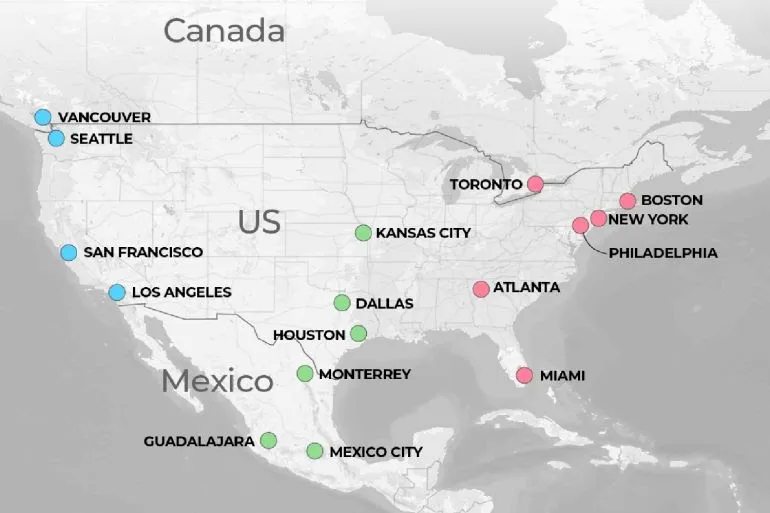
The FIFA World Cup 2026 is poised to become the most ambitious and expansive tournament in football history. Scheduled to be held across the United States, Canada and Mexico from June 11 to July 19, the competition will introduce a groundbreaking 48-team format, significantly expanding opportunities for nations across the globe. The tournament will feature more matches, broader continental representation and an enhanced knockout structure designed to increase competitiveness and fan engagement. As football's premier event enters a new era, the 2026 World Cup is expected to deliver unprecedented economic impact, global viewership and sporting drama while reshaping the future of international football.
A New Era Begins for the FIFA World Cup
The 2026 FIFA World Cup will mark one of the most significant milestones in the history of the sport. For the first time, the tournament will be jointly hosted by three nations—the United States, Canada and Mexico—creating an event of unparalleled scale and complexity.
Equally significant is the expansion of the competition from 32 to 48 participating teams. The move reflects football's growing global appeal and FIFA's broader strategy of increasing representation from emerging football regions. The enlarged field is expected to provide more countries with an opportunity to compete on the world's biggest sporting stage while introducing fresh competitive dynamics.
The tournament will run for nearly six weeks, bringing together elite football talent from every corner of the globe in what is expected to be the largest sporting spectacle ever organized.
Expansion to 48 Teams Changes the Competitive Landscape
One of the defining features of the 2026 World Cup is the introduction of a 48-team structure, replacing the 32-team format that has been in place since 1998.
The expansion represents the latest step in the tournament's evolution. Before the 32-team era, the World Cup featured 24 teams between 1982 and 1994, while earlier editions included only 16 participants.
The new format significantly broadens participation, creating opportunities for nations that historically struggled to qualify due to limited allocation slots within their respective confederations. Football authorities believe the change will strengthen the game's development worldwide while fostering greater inclusivity.
For supporters, the larger tournament promises a wider variety of matchups, emerging football stories and the possibility of new nations making deep runs into the competition.
Qualification Process Delivers Global Representation
The qualification journey for the 2026 World Cup has been one of the most extensive in football history, spanning multiple years and involving national teams from FIFA's six continental confederations.
As host nations, the United States, Canada and Mexico secured automatic qualification. The remaining 45 positions were earned through regional qualification campaigns that tested teams across Africa, Asia, Europe, North America, South America and Oceania.
The expanded format has enabled increased representation from traditionally underrepresented football regions, a development widely viewed as a positive step toward strengthening the sport's global footprint.
The result is a more diverse field of competitors that better reflects football's worldwide popularity.
Innovative Group Stage Structure
To accommodate the larger number of participating teams, organizers have introduced a revised tournament structure designed to balance fairness with competitive excitement.
The 48 teams will be divided into 12 groups of four nations each. The top two teams from every group will automatically advance to the knockout stage.
Additionally, the eight best third-placed teams will secure qualification, creating a 32-team knockout bracket for the first time in World Cup history.
This expanded knockout phase introduces an additional elimination round, increasing the number of high-stakes matches and ensuring that more teams remain competitive deeper into the tournament.
Analysts believe the format strikes a balance between inclusivity and sporting merit, while maintaining the drama that defines World Cup football.
Host Nations Prepare for a Global Showcase
The joint hosting arrangement provides a unique opportunity for North America to showcase its sporting infrastructure and organizational capabilities.
The United States will host the majority of matches, leveraging its extensive network of modern stadiums and transportation facilities. Canada will welcome World Cup matches for the first time, while Mexico will become the first nation to host matches in three separate World Cup tournaments.
The event is expected to attract millions of visitors, generating substantial economic activity across host cities through tourism, hospitality, transportation and entertainment spending.
Local governments and businesses have already invested heavily in preparations, anticipating one of the largest international sporting gatherings ever staged.
Economic and Commercial Impact Expected to Break Records
Beyond the action on the pitch, the World Cup is projected to deliver significant financial benefits for stakeholders across the football ecosystem.
Broadcasting agreements, sponsorship deals, merchandising revenues and tourism spending are expected to reach unprecedented levels. The tournament's expanded format creates additional inventory for broadcasters and advertisers, enhancing its commercial appeal.
For host cities, the influx of international visitors is expected to provide a substantial boost to local economies, while businesses across hospitality and service sectors prepare for heightened demand.
The event also presents a strategic opportunity to accelerate football's growth in North America, where the sport continues to gain popularity among younger audiences.
A Tournament Designed for the Future
The 2026 FIFA World Cup represents more than an expansion in size; it signals a transformation in how global football's premier event is structured and delivered.
By increasing participation, introducing a larger knockout stage and embracing a multi-country hosting model, the tournament aims to make football's biggest stage more inclusive and globally representative than ever before.
The expanded format may also produce new football powers and unexpected success stories, adding another layer of intrigue to an already compelling competition.
Looking Ahead
As the countdown to kickoff continues, anticipation is building for what many expect to be the most influential World Cup ever held. With 48 teams, three host nations and a reimagined tournament structure, the 2026 edition promises to redefine international football on and off the field.
For players, supporters, sponsors and host nations alike, the competition represents a historic opportunity to participate in a sporting event unlike any seen before. If expectations are met, the FIFA World Cup 2026 will not only crown a world champion but also establish a new benchmark for the future of global football.
Comments