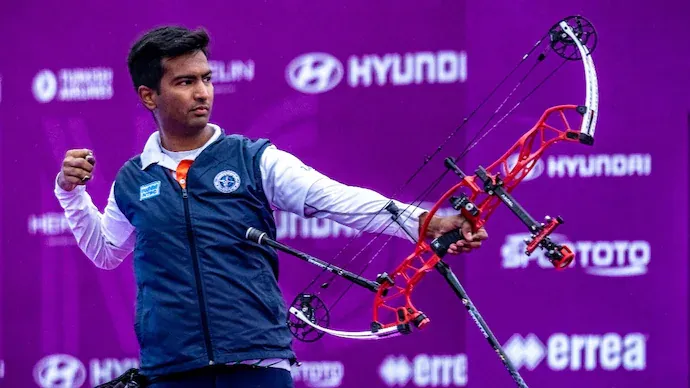
Indian archery continues to be shaped by established international performers such as Deepika Kumari, Atanu Das, and Jyothi Surekha Vennam, who have consistently carried the nation’s medal ambitions across global competitions. Deepika remains a benchmark for composure and consistency under pressure, while Jyothi has emerged as the leading force behind India’s compound archery success. Alongside this experienced core, young archer Rishabh Yadav represents a new generation injecting energy and optimism into the sport. Despite steady international progress, India continues to pursue its most significant objective—translating sustained world-stage competitiveness into Olympic medals, a goal that remains unfulfilled.
Established Pillars of Indian Archery
Indian archery’s global identity has been built over years by a select group of elite athletes who have consistently delivered at the highest level.
Deepika Kumari remains one of the most influential figures in the sport. Known for her technical precision and mental resilience, she has repeatedly demonstrated the ability to compete under intense pressure on the world stage.
In the men’s recurve category, Atanu Das has contributed significantly to India’s international presence, particularly in team events and major championship cycles.
Meanwhile, in the compound discipline, Jyothi Surekha Vennam has become a defining force, leading India’s rise in a category where the country has increasingly established itself as a global contender.
Together, these athletes form the competitive backbone of Indian archery at the international level.
The Emergence of Rishabh Yadav
Alongside established names, Rishabh Yadav represents the next wave of Indian archery talent.
Characterized by his youthful confidence and calm demeanor, Rishabh brings a refreshing energy to a sport that demands precision, patience, and mental stability. His presence signals a gradual but important generational shift within the Indian archery ecosystem.
While still in the early phase of his international journey, his development reflects the increasing depth of India’s talent pipeline, which is beginning to produce athletes capable of competing consistently at the global level.
India’s Continued Olympic Aspirations
Despite consistent success across World Cups, Asian Championships, and other international tournaments, Olympic success remains the missing piece in India’s archery narrative.
Athletes such as Deepika Kumari and Atanu Das have brought India close to elite Olympic contention, yet the final breakthrough has remained elusive.
This gap highlights the extreme competitiveness of Olympic archery, where margins are minimal and psychological endurance often determines outcomes more than technical ability alone.
For India, the challenge is not only to qualify or compete but to consistently convert global experience into podium finishes at the Olympic level.
Compound Archery: India’s Growing Competitive Advantage
A significant development in recent years has been the rise of compound archery as a strong medal-producing discipline for India.
Jyothi Surekha Vennam has played a central role in this transformation, helping India establish itself as a consistent performer in international compound events.
This diversification has strengthened India’s overall archery ecosystem by reducing over-reliance on recurve events and expanding the country’s medal prospects across multiple categories.
The success in compound archery also reflects improved infrastructure, training methodologies, and athlete specialization within the sport.
Balancing Experience and Youth in a Competitive Ecosystem
Indian archery is currently undergoing a phase of structural transition, where seasoned performers and emerging talent are coexisting within the same competitive framework.
Veterans like Deepika Kumari provide stability and experience, while younger athletes such as Rishabh Yadav bring freshness and long-term potential.
This balance is crucial for sustained international success, as it allows for continuity while simultaneously preparing the next generation for elite competition.
Such a dual structure is often essential in precision sports, where long-term performance cycles depend on both experience-driven consistency and youthful adaptability.
The Road Ahead: Converting Promise Into Olympic Success
India’s archery program stands at an important crossroads. While the country has established itself as a consistent force in global competitions, the ultimate benchmark—Olympic medals—remains unachieved.
The presence of high-performing athletes like Deepika Kumari, Atanu Das, Jyothi Surekha Vennam, and emerging talents such as Rishabh Yadav provides a strong foundation for future success.
However, converting consistent international competitiveness into Olympic podium finishes will require not only technical excellence but also sustained mental conditioning, strategic investment, and exposure to high-pressure environments.
For now, Indian archery continues its steady evolution—progressing, diversifying, and preparing for the breakthrough it has long pursued on the world’s biggest sporting stage.
Comments