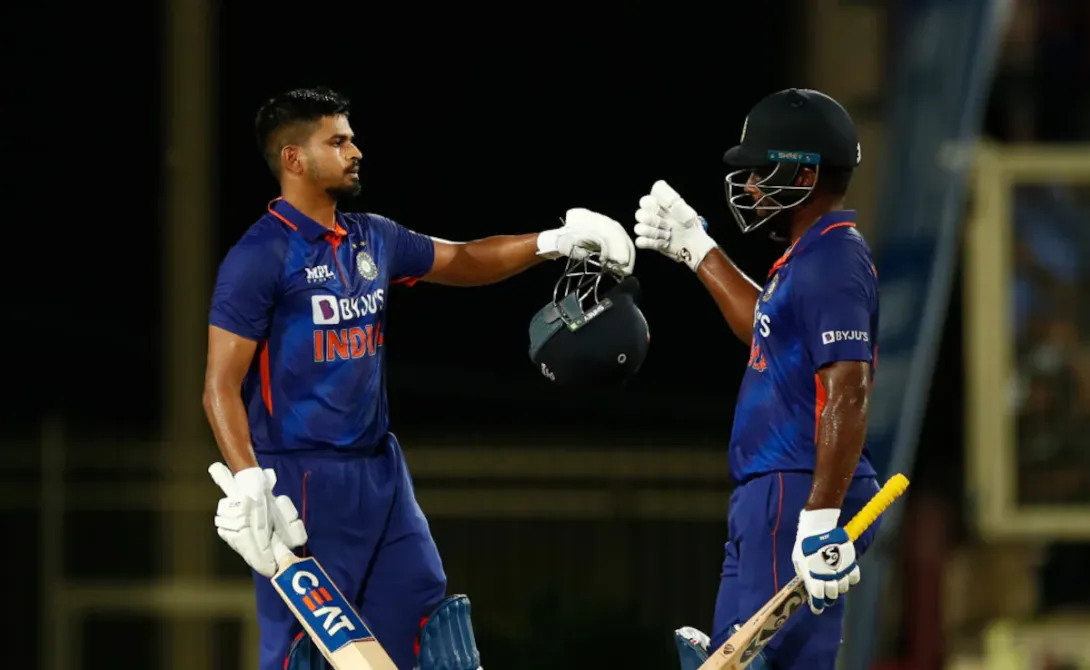
India’s T20I leadership landscape appears to be entering a decisive transition phase, with growing reports indicating that selectors are evaluating alternative captaincy options ahead of future international assignments. Shreyas Iyer and Sanju Samson have emerged as prominent contenders as discussions intensify over the long-term direction of India’s white-ball setup. Samson’s strong IPL 2026 performances for Chennai Super Kings and his previous captaincy tenure with Rajasthan Royals have strengthened his credentials, while Iyer continues to be viewed as a tactically astute leader with proven experience under pressure. The debate reflects India’s broader strategy of succession planning as the team prepares for a rapidly evolving era of international T20 cricket.
India’s T20I Leadership Transition Appears Increasingly Likely
Indian cricket may soon witness another major leadership transition in the T20I format as speculation surrounding the national captaincy continues to intensify.
According to multiple reports and sources within cricketing circles, selectors are actively assessing future leadership options amid growing uncertainty over the long-term continuation of the current T20I captaincy structure.
Among the names gaining significant traction are Shreyas Iyer and Sanju Samson — two players viewed as capable of guiding India through the next phase of white-ball cricket.
While the Board of Control for Cricket in India (BCCI) has not issued any official statement regarding leadership changes, the frequency and consistency of reports suggest that discussions surrounding succession planning are already underway internally.
In Indian cricket, such developments rarely emerge publicly without substantial strategic consideration behind the scenes.
Sanju Samson’s Revival Has Elevated His Leadership Credentials
Sanju Samson’s inclusion in the captaincy debate marks a remarkable shift in perception around the wicketkeeper-batter’s role within Indian cricket.
After joining Chennai Super Kings ahead of IPL 2026, Samson has delivered a series of influential performances that have significantly strengthened his standing among selectors and analysts. His batting form, combined with his calm temperament, has reintroduced him into conversations surrounding India’s long-term leadership plans.
Although Samson does not currently captain Chennai Super Kings, his previous tenure as Rajasthan Royals skipper remains an important factor in his evaluation.
During his time leading Rajasthan, Samson developed a reputation for maintaining composure under pressure and handling tactical responsibilities effectively in one of the most demanding franchise leagues globally.
Leadership in modern T20 cricket increasingly involves more than aggressive field placements or bowling changes. Team management now values emotional intelligence, communication skills, adaptability, and dressing-room influence — areas in which Samson is widely considered strong.
His resurgence therefore arrives at an important moment for Indian cricket’s evolving leadership structure.
Shreyas Iyer Continues to Command Strong Support
While Samson’s rise has captured attention, Shreyas Iyer remains one of the strongest contenders for India’s future T20I captaincy.
Iyer has steadily built a reputation as one of India’s most tactically disciplined white-ball cricketers, with considerable leadership experience accumulated through IPL and domestic cricket.
His ability to balance aggressive batting intent with strategic clarity has made him particularly attractive to selectors seeking stability in a rapidly changing T20 environment.
Importantly, Iyer is also viewed as a player capable of anchoring the middle order while simultaneously managing leadership responsibilities — a dual role increasingly valued in modern international cricket.
Many analysts believe his calm decision-making and tactical awareness align naturally with the demands of contemporary T20 captaincy, where rapid adaptation and situational management have become critical.
The fact that both Iyer and Samson are now being discussed seriously suggests India may be preparing for a broader restructuring rather than a temporary leadership adjustment.
IPL Has Become India’s Leadership Testing Ground
The ongoing captaincy discussion highlights the growing influence of the Indian Premier League in shaping national leadership decisions.
Franchise cricket has evolved into more than a domestic competition. It now functions as an advanced evaluation platform where selectors observe leadership behavior under sustained pressure, intense media scrutiny, and complex tactical situations.
Captains in the IPL are required to manage international stars, adapt to fast-changing match scenarios, and maintain dressing-room stability throughout a demanding tournament schedule.
As a result, IPL leadership experience increasingly carries substantial weight in national team succession planning.
Both Shreyas Iyer and Sanju Samson have benefited from operating within that environment, strengthening their profiles as viable candidates for future international leadership roles.
The transition also reflects how Indian cricket’s leadership pipeline has become deeply integrated with franchise cricket structures.
T20 Cricket Demands a Different Kind of Captain
The growing speculation around leadership change also underscores how dramatically the T20 format has evolved over the past decade.
Modern T20 cricket is now heavily influenced by analytics, matchup strategies, workload management, and ultra-aggressive tactical philosophies. Captains are expected to process information rapidly while maintaining clarity under constant pressure.
Selectors are therefore increasingly prioritizing adaptability and tactical flexibility over traditional leadership hierarchies.
The next Indian T20I captain will likely be expected not only to manage on-field strategy but also to guide a younger generation of players through a format becoming progressively faster and more unpredictable.
This broader shift explains why leadership conversations are now centered around players perceived as modern tactical thinkers rather than merely senior squad members.
Chennai Super Kings’ Influence Adds Strategic Value
Samson’s association with Chennai Super Kings may further enhance perceptions surrounding his leadership suitability.
CSK remains one of the IPL’s most professionally managed franchises, renowned for its leadership culture, tactical discipline, and stable dressing-room environment. Players operating within that structure often gain exposure to high-level strategic planning and experienced mentorship systems.
Although Samson is not leading the side, performing consistently within such an environment may strengthen confidence among selectors regarding his maturity and game understanding.
Historically, several Indian captains have emerged after developing within successful IPL ecosystems.
That pattern appears increasingly relevant once again.
India’s White-Ball Future Is Entering a Defining Phase
The debate surrounding India’s T20I captaincy emerges at a time when the national team is navigating a broader generational transition.
Several established players are approaching the later stages of their T20 careers, while younger cricketers continue establishing themselves through the IPL and international assignments.
Managing that transition effectively will be essential if India hopes to remain a dominant force in global white-ball cricket.
Leadership decisions made now could shape team culture, tactical identity, and long-term competitiveness for years to come.
Selectors therefore appear focused on identifying a captain capable not only of winning matches but also of managing an evolving squad during one of the most important transition periods in recent Indian cricket history.
Succession Planning Appears Already Underway
Although official confirmation remains absent, the increasing volume of reports surrounding Shreyas Iyer and Sanju Samson strongly suggests India’s T20I leadership future is already under serious internal discussion.
Whether the change occurs immediately or gradually, the emergence of multiple contenders indicates a deliberate attempt to prepare for the next era rather than react to sudden instability.
For Indian cricket, the challenge is no longer simply identifying the next captain.
It is selecting the leader capable of navigating a rapidly evolving global T20 landscape where tactical innovation, player management, and strategic adaptability increasingly determine success at the highest level.
Comments