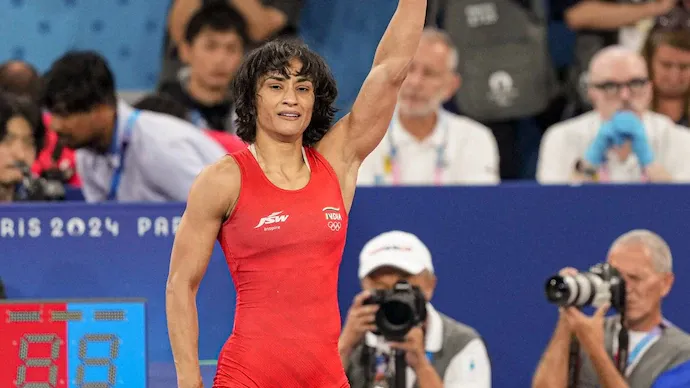
Olympian Vinesh Phogat has intensified her ongoing standoff with the Wrestling Federation of India (WFI) after posting a cryptic but defiant message on social media following her exclusion from the National Open Ranking tournament. The development has reignited scrutiny over governance practices, athlete rights, and administrative transparency within Indian wrestling. While the WFI’s decision to bar the decorated wrestler from competition has generated controversy across sporting circles, Vinesh’s response suggests she is prepared to continue challenging the federation publicly. The episode reflects broader tensions between elite athletes and sports administrators in India, raising important questions about institutional accountability, athlete empowerment, and the future direction of Indian wrestling governance.
Vinesh Phogat Signals Resistance After WFI Decision
Indian wrestling star Vinesh Phogat has once again found herself at the center of a high-profile sporting controversy after responding publicly to the Wrestling Federation of India’s decision to bar her from competing in the National Open Ranking tournament.
Shortly after the federation’s move became public, Vinesh posted a cryptic message on social media that many interpreted as a clear indication she does not intend to retreat from her confrontation with the governing body.
Although the wrestler refrained from directly naming officials or detailing the circumstances surrounding the dispute, the tone of her statement conveyed resistance and determination rather than compromise.
The response immediately triggered widespread discussion among athletes, supporters, and sports commentators, further intensifying attention on the deteriorating relationship between one of India’s most celebrated wrestlers and the federation overseeing the sport.
WFI’s Decision Raises Questions Over Governance
The Wrestling Federation of India’s decision to prevent Vinesh from participating in the ranking tournament has renewed broader concerns surrounding governance structures within Indian wrestling.
National ranking events are critical within the competitive ecosystem of the sport, often influencing athlete selection pathways, performance assessments, and eligibility for future international competitions. Exclusion from such tournaments therefore carries significant professional implications.
The federation’s move has prompted renewed debate regarding procedural fairness, administrative transparency, and communication standards between governing bodies and elite athletes.
Over recent years, Indian wrestling has repeatedly experienced turbulence linked to governance disputes, athlete protests, and administrative controversies. The latest episode involving Vinesh Phogat adds another chapter to a period of sustained institutional instability.
Observers within Indian sport increasingly argue that such recurring confrontations risk undermining athlete confidence and disrupting long-term development systems.
Vinesh Phogat’s Influence Extends Beyond Wrestling
Vinesh Phogat’s significance within Indian sport extends far beyond her achievements on the wrestling mat.
As one of India’s most recognizable female athletes, she has emerged as an influential public figure capable of shaping conversations around athlete welfare, institutional accountability, and gender representation in sports governance.
Her willingness to publicly challenge authority structures has transformed her into a symbol of athlete resistance for many supporters, particularly during previous disputes involving sports administration.
This broader public identity explains why even indirect social media statements from Vinesh generate substantial national attention.
The latest post was interpreted not merely as personal frustration but as a calculated signal that she intends to continue confronting the federation despite administrative pressure.
In modern sport, athletes with strong public credibility increasingly possess the ability to shape institutional narratives independently of official governing bodies.
Social Media Is Changing Power Dynamics in Indian Sport
The controversy also highlights how digital platforms are transforming relationships between athletes and sporting institutions.
Historically, sports federations controlled public communication surrounding disciplinary matters and administrative decisions. Social media has dramatically altered that balance by allowing athletes to communicate directly with millions of supporters in real time.
Vinesh’s cryptic post became a national talking point within hours, illustrating how elite athletes can now influence public sentiment without formal press conferences or institutional mediation.
This shift has fundamentally changed governance dynamics in professional sport. Public perception increasingly influences how administrative decisions are viewed, forcing federations to operate under significantly greater scrutiny than in previous decades.
For sports administrators, reputational management has therefore become as important as regulatory authority.
Indian Wrestling Continues to Face Structural Challenges
Indian wrestling remains one of the country’s strongest Olympic disciplines, consistently producing international-level athletes and generating national recognition. However, administrative instability has repeatedly threatened to overshadow those sporting achievements.
Disputes involving athlete selection, federation management, and governance accountability have created persistent uncertainty within the wrestling ecosystem.
Such instability can carry long-term consequences for athlete preparation, sponsorship opportunities, and international competitiveness. Elite athletes require structural clarity and institutional trust to perform consistently at the highest level.
The situation involving Vinesh Phogat therefore reflects more than an isolated disagreement. It exposes deeper structural tensions regarding athlete representation, transparency, and the concentration of authority within Indian sports governance.
As India continues investing heavily in Olympic ambitions, resolving these institutional weaknesses is becoming increasingly important.
Commercial and Reputational Stakes Are Rising
The public nature of the dispute also carries broader commercial and reputational implications for Indian wrestling.
Athletes such as Vinesh Phogat are not only competitors but also influential public personalities with significant brand value, endorsement potential, and media visibility. Prolonged disputes between elite athletes and governing bodies can affect sponsor confidence and damage the sport’s broader public image.
For sports federations operating in an increasingly commercialized environment, credibility and governance standards directly influence stakeholder trust.
Internationally, repeated administrative controversies risk creating perceptions of instability within Indian sporting systems at a time when the country is seeking to strengthen its global sporting reputation.
The federation’s handling of high-profile disputes will therefore likely remain under close public and institutional observation.
Confrontation Appears Far From Over
At present, there is little indication that tensions between Vinesh Phogat and the Wrestling Federation of India are nearing resolution.
Her latest social media response strongly suggests that she remains unwilling to accept the federation’s position quietly and intends to continue resisting what she appears to view as institutional unfairness.
For the WFI, the issue has now evolved beyond tournament participation alone. It has become part of a larger debate surrounding governance legitimacy, athlete empowerment, and accountability within Indian sport.
As the controversy continues to attract public attention, pressure is likely to intensify on both the athlete and the federation.
In the modern sporting landscape, conflicts involving high-profile athletes rarely remain confined to administrative corridors. Instead, they increasingly unfold in full public view — shaped as much by perception and narrative as by formal decisions themselves.
Comments