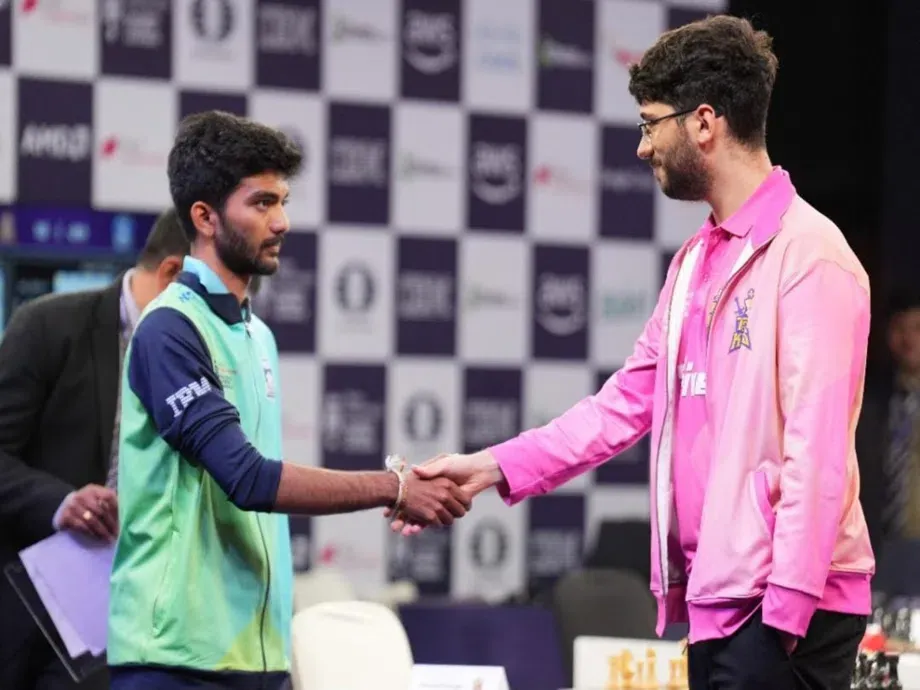
Reigning world chess champion D Gukesh delivered a commanding performance against Javokhir Sindarov, securing a strategically brilliant 52-move victory that reinforced his status as one of the most formidable players in modern chess. The triumph arrives at a crucial stage as Gukesh intensifies preparations for the defense of his World Championship crown. More than a routine competitive result, the victory served as a powerful signal to the global chess fraternity regarding his confidence, tactical maturity, and sustained dominance. As international chess enters a new generational era, Gukesh continues to position himself not merely as a champion, but as a defining figure shaping the future of the sport.
Gukesh Delivers a Timely Reminder of His Dominance
World champion D Gukesh once again demonstrated why he remains at the pinnacle of international chess, defeating Javokhir Sindarov in a high-quality encounter that highlighted his growing authority within the sport.
The 52-move victory carried significance beyond the scoreboard. With attention increasingly turning toward his upcoming World Championship title defense, Gukesh used the contest to reinforce perceptions of his tactical sharpness, positional understanding, and psychological resilience.
Against a highly talented opponent regarded as one of the emerging stars of global chess, the Indian grandmaster maintained composure throughout the contest, gradually tightening his strategic grip before converting his advantage with clinical efficiency.
The result effectively served as a statement to rivals that the reigning champion remains fully prepared for the challenges ahead.
Strategic Excellence Defines the Match
Gukesh’s victory was shaped by exceptional strategic discipline rather than speculative aggression. From the opening stages, he demonstrated superior positional judgment, carefully constructing pressure through coordinated piece activity and long-term planning.
Instead of pursuing immediate tactical complications, Gukesh adopted a measured approach designed to restrict Sindarov’s counterplay while steadily improving his own position. Such maturity is increasingly becoming a hallmark of his playing style.
As the middle game unfolded, the Indian champion identified critical structural weaknesses within Sindarov’s setup and exploited them with remarkable precision. The gradual accumulation of small advantages eventually transformed into a decisive endgame edge, leaving little room for recovery.
The performance reflected not only technical sophistication but also the patience and control associated with elite world champions.
A Crucial Psychological Boost Ahead of Title Defense
The timing of the victory adds further importance to the achievement. Defending a World Championship title represents one of the most demanding challenges in professional chess, requiring not only technical preparation but also extraordinary psychological endurance.
Every appearance by a reigning champion is scrutinized intensely by competitors, analysts, and global audiences searching for signs of vulnerability. In this context, dominant performances carry symbolic value far beyond individual results.
By defeating Sindarov convincingly, Gukesh has strengthened the perception that he remains fully in command of his game ahead of his title defense campaign. The victory also reinforces confidence within his preparation team while simultaneously increasing pressure on potential challengers.
For the broader chess community, the match served as a reminder that Gukesh is entering the next phase of his career with growing maturity rather than complacency.
India’s Chess Revolution Continues to Gather Momentum
Gukesh’s rise has become emblematic of India’s expanding influence in global chess. Over the past decade, the country has transformed into one of the world’s most productive centers for elite chess talent, producing a new generation of grandmasters capable of competing consistently at the highest level.
The foundation for this transformation was laid by Viswanathan Anand, whose achievements inspired widespread interest in the game across India. That legacy is now evolving into a broader institutional ecosystem supported by academies, digital learning platforms, and increasing corporate investment.
Gukesh’s continued success represents the maturation of that system. Rather than emerging as an isolated prodigy, he reflects the growing depth and competitiveness of Indian chess development structures.
His performances are also enhancing India’s reputation as a major force in intellectual sports, expanding the country’s global sporting influence beyond traditional disciplines.
Commercial Growth Elevates Chess Into Mainstream Spotlight
The increasing prominence of world champions such as Gukesh coincides with the rapid commercial expansion of chess globally. Digital streaming platforms, online tournaments, and rising audience engagement have transformed chess into a far more visible and commercially attractive sport than in previous decades.
Elite players now operate not only as competitors but also as influential public personalities capable of attracting sponsorships, media partnerships, and global fan engagement.
India’s vast digital audience has made the country a particularly important market in chess’s commercial evolution. Gukesh’s ascent has already contributed to growing corporate interest in the sport, with brands increasingly recognizing chess as a platform associated with intelligence, discipline, and strategic excellence.
Continued international success from Indian players could significantly accelerate investment in professional chess infrastructure and youth development programs across the country.
Sindarov Represents the Sport’s Emerging Competitive Depth
Although defeated, Javokhir Sindarov remains one of the most respected young talents in world chess. His ability to compete regularly against elite opposition highlights the increasing depth and competitiveness of the sport’s next generation.
Modern chess is experiencing a generational transformation driven by advanced computer-assisted preparation, deeper opening theory, and increasingly aggressive playing styles among younger grandmasters.
Encounters between players such as Gukesh and Sindarov are therefore viewed as more than isolated matches; they represent the emerging rivalries likely to shape the future landscape of elite chess over the coming decade.
Gukesh Moves Closer Toward Defining an Era
For D Gukesh, the victory over Sindarov marks another important step in the evolution from prodigious talent to long-term champion.
What increasingly separates Gukesh from many contemporaries is not merely his technical brilliance but his composure under pressure and his capacity for sustained strategic control. These qualities are often the defining characteristics of players who establish enduring legacies in world chess.
As preparations intensify for his World Championship title defense, Gukesh appears determined not only to retain his crown but also to shape the competitive identity of modern chess itself.
The global chess community may now be witnessing the early stages of a new dominant era — one led by a champion whose influence extends well beyond the chessboard.
Comments