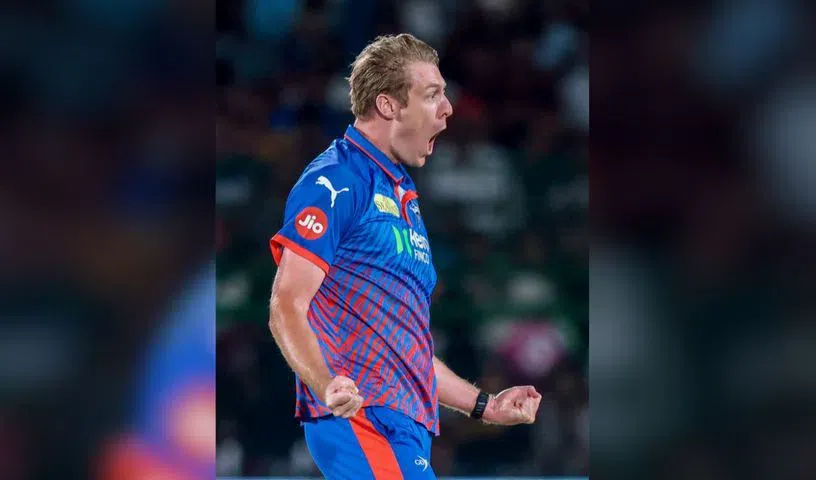
Governance and discipline in the Indian Premier League were reinforced after Kyle Jamieson of Delhi Capitals received a demerit point and official warning for violating the league’s code of conduct. The breach followed an aggressive on-field exchange after the dismissal of Vaibhav Sooryavanshi during a match against Rajasthan Royals. While the incident was contained, the league’s response highlights its commitment to professionalism, ensuring that competitive intensity does not undermine the IPL’s commercial value, regulatory framework, and global brand credibility.
Incident Overview: A Moment of Excess
The disciplinary action against Kyle Jamieson stems from an on-field incident during a high-pressure IPL fixture. Following the dismissal of Vaibhav Sooryavanshi, Jamieson was involved in an animated and aggressive interaction, drawing the attention of match officials.
Although the situation did not escalate into a larger confrontation, it was deemed a breach of the IPL’s code of conduct. The governing body responded with a demerit point and a formal warning—penalties that reflect both accountability and proportionality.
Understanding the IPL’s Code of Conduct
The IPL maintains a structured code of conduct to regulate player behavior and uphold the integrity of the competition. The framework categorizes offenses and prescribes penalties ranging from warnings to fines and suspensions.
Demerit points act as a cumulative system, where repeated violations can lead to stricter sanctions. This mechanism ensures that even relatively minor infractions are recorded and monitored, reinforcing long-term discipline across the league.
Such governance structures are essential in a tournament that commands global attention and operates within a high-value commercial ecosystem.
Commercial Implications and Brand Protection
The IPL is not merely a sporting event—it is a multi-billion-rupee enterprise driven by media rights, sponsorships, and franchise investments. In this context, player conduct has direct implications for brand perception.
Incidents of on-field aggression, if left unchecked, risk undermining the league’s image as a professionally managed property. By acting swiftly, the IPL safeguards its reputation and reassures stakeholders, including broadcasters and advertisers, of its commitment to high standards.
Maintaining discipline is therefore as much a business imperative as it is a sporting necessity.
Balancing Competitive Intensity and Professionalism
Elite-level cricket is inherently intense, with players operating under significant psychological and physical pressure. Emotional reactions are often part of the game, particularly in pivotal moments.
However, leagues like the IPL demand that players strike a balance between passion and professionalism. Jamieson’s case serves as a reminder that while competitive spirit is encouraged, it must remain within defined behavioral boundaries.
This balance is critical to preserving both the spirit of the game and the expectations of a global audience.
Governance and the Future of the League
The IPL’s handling of the incident reflects a mature governance model that prioritizes consistency and transparency. As the league continues to expand its international footprint, maintaining strict disciplinary standards becomes increasingly important.
From a strategic perspective, robust governance enhances investor confidence and sets a benchmark for emerging sports leagues. It also reinforces the IPL’s position as a leader in sports administration and commercial innovation.
Conclusion: Discipline as a Pillar of Sustainability
The sanction imposed on Kyle Jamieson may appear minor in isolation, but it carries broader significance for the IPL’s operational philosophy. By enforcing its code of conduct, the league underscores that discipline is integral to sustainable growth.
In an environment where sport and business intersect, maintaining order on the field is essential to preserving value off it. The incident ultimately reinforces a simple principle: professionalism remains non-negotiable in modern competitive sport.
Comments