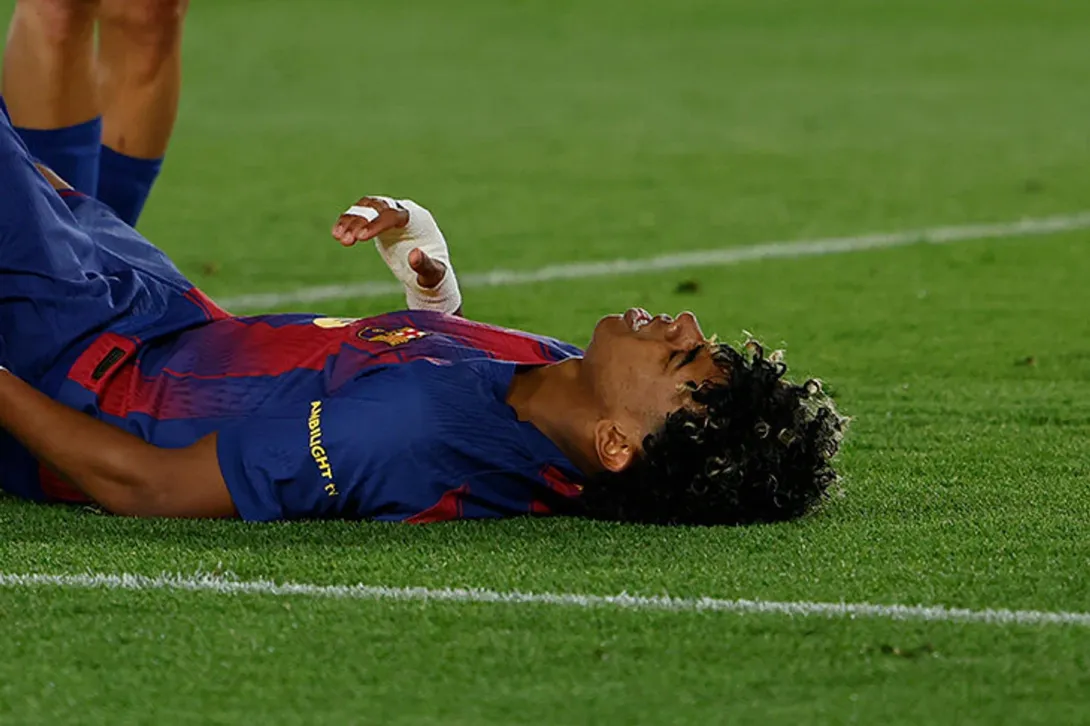
Lamine Yamal has been ruled out for the remainder of the season following an injury sustained during a La Liga clash against Celta Vigo. The setback sidelines one of FC Barcelona’s most promising assets, raising both sporting and commercial concerns. While medical assessments confirm he will miss the rest of the campaign, the 17-year-old is expected to recover in time for the FIFA World Cup. Barcelona’s cautious stance on his return reflects a broader shift toward long-term player value preservation in an increasingly high-stakes football economy.
Injury Disrupts Barcelona’s Tactical Continuity
Barcelona’s campaign has encountered a significant disruption with the loss of Lamine Yamal, whose emergence has been one of the season’s defining narratives. The injury occurred during a penalty attempt in a league fixture against Celta Vigo, forcing his immediate withdrawal.
Subsequent medical evaluations have confirmed that he will not return before the season concludes. For Barcelona, this absence affects more than squad depth—it alters attacking dynamics and limits tactical flexibility at a critical juncture.
Financial Implications of a Rising Star’s Absence
In contemporary football, elite young players represent both sporting potential and commercial capital. Yamal’s rapid rise has elevated his profile, making him a valuable asset in terms of brand partnerships, fan engagement, and long-term valuation.
His absence could marginally impact matchday appeal and global viewership, particularly as younger audiences increasingly gravitate toward emerging stars. Clubs now operate at the intersection of performance and marketability, where player availability directly influences revenue streams.
Risk Management and Long-Term Planning
Barcelona’s intention to adopt a cautious approach toward Yamal’s recovery reflects a strategic recalibration. Rather than accelerating his return, the club appears focused on safeguarding his long-term fitness and career trajectory.
This aligns with a broader industry trend where clubs leverage sports science, injury analytics, and workload monitoring to mitigate risk. Protecting high-value players is not merely a medical decision—it is a financial imperative in a competitive global market.
Spain’s World Cup Considerations
Despite the setback, Yamal is expected to be fit for Spain’s World Cup campaign. However, early-stage deployment may be carefully managed to prevent recurrence or aggravation of the injury.
For national teams, integrating young talent into high-pressure tournaments requires balancing immediate performance objectives with long-term player welfare. Spain’s handling of Yamal could influence both tournament outcomes and the player’s developmental trajectory.
Conclusion: A Calculated Pause in a Promising Career
Lamine Yamal’s injury represents a short-term setback with broader strategic implications. For Barcelona, the focus shifts from immediate results to long-term asset preservation, ensuring that one of football’s brightest prospects returns at full capacity.
In an era where the economics of sport are increasingly intertwined with player performance, such decisions reflect a measured approach to risk and reward. The priority now is clear: protect the asset, manage recovery, and prepare for a return that aligns with both sporting ambition and financial prudence.
Comments