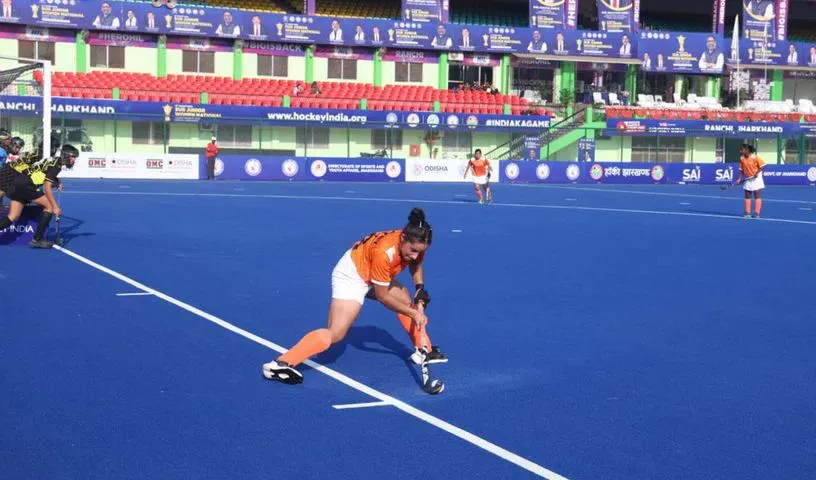
A 16-year-old hockey player from a remote border district in Jammu and Kashmir has secured a place in India’s Under-18 National Coaching Camp, underscoring the growing reach of grassroots sports development. Akshra Dutta’s selection follows a standout performance at a national sub-junior tournament, where her goal-scoring ability propelled her team to promotion. Emerging from a region with limited infrastructure, her journey reflects both individual determination and systemic progress in talent identification. The development also signals how structured competitions are reshaping India’s athletic pipeline, unlocking value from underrepresented geographies and strengthening the long-term prospects of the country’s hockey ecosystem.
A Rare Breakthrough from the Border Districts
In the remote district of Poonch—located just eight kilometers from the Line of Control—sporting infrastructure remains limited and opportunities scarce. Yet, against this backdrop, Akshra Dutta has emerged as a promising young athlete, earning a spot in the Under-18 National Coaching Camp conducted by Hockey India.
The camp, hosted at the Sports Authority of India in Bhopal, serves as a critical feeder system for identifying and nurturing future national-level players. For athletes from underserved regions, such platforms represent a rare gateway into elite sport.
Tournament Performance Drives National Selection
Akshra’s selection is anchored in performance metrics rather than promise alone. At the 16th Hockey India Sub Junior Women National Championship 2026 Division C, she delivered a high-impact showing while representing Hockey Jammu and Kashmir.
Scoring four field goals during the competition, she finished as the second-highest scorer in her division—an outcome that reflects both consistency and attacking efficiency. Her contributions were instrumental in Jammu and Kashmir’s strong campaign, as the team topped Pool B and secured promotion to Division B for the upcoming season.
From a performance analytics standpoint, such output in a national tournament significantly enhances a player’s selection probability, particularly in a system increasingly driven by measurable outcomes.
Structural Gaps and Emerging Opportunities
Akshra’s journey also underscores the persistent disparities in India’s sports infrastructure. Border districts like Poonch often operate with constrained resources, limited coaching expertise, and minimal exposure to competitive circuits. These structural inefficiencies can suppress talent emergence, effectively reducing the overall yield of the country’s athletic ecosystem.
However, national-level tournaments are gradually mitigating this imbalance. By offering a meritocratic platform, they enable athletes from peripheral regions to enter mainstream pathways. In economic terms, this represents a more efficient allocation of human capital—identifying high-potential individuals irrespective of geography.
Implications for India’s Hockey Talent Pipeline
The broader significance of Akshra’s rise lies in what it signals for Indian hockey’s developmental strategy. Hockey India has increasingly emphasized decentralized scouting and structured competitions to widen its talent base. This approach is beginning to yield measurable dividends.
By integrating players from non-traditional regions, the governing body is not only diversifying its talent pool but also enhancing competitive depth. Over time, such inclusivity could translate into stronger national squads and improved international performance.
The Road Ahead: From Potential to Performance
Selection to the national camp marks a pivotal inflection point rather than a final achievement. Training at the Sports Authority of India facility will expose Akshra to advanced coaching methodologies, sports science frameworks, and high-intensity competition.
The transition from regional standout to national contender demands sustained discipline, adaptability, and performance under pressure. If successfully navigated, this pathway could lead to junior national team selection and, eventually, representation at the senior level.
Conclusion
Akshra Dutta’s progression from a geographically constrained environment to the national training circuit encapsulates a broader shift in Indian sport. It reflects a system gradually evolving toward inclusivity and efficiency, where talent identification is less dependent on location and more aligned with performance.
For policymakers, her journey reinforces the need for continued investment in grassroots infrastructure. For the sporting community, it serves as evidence that excellence can emerge from the margins—provided there is a mechanism to recognize and nurture it.
Comments