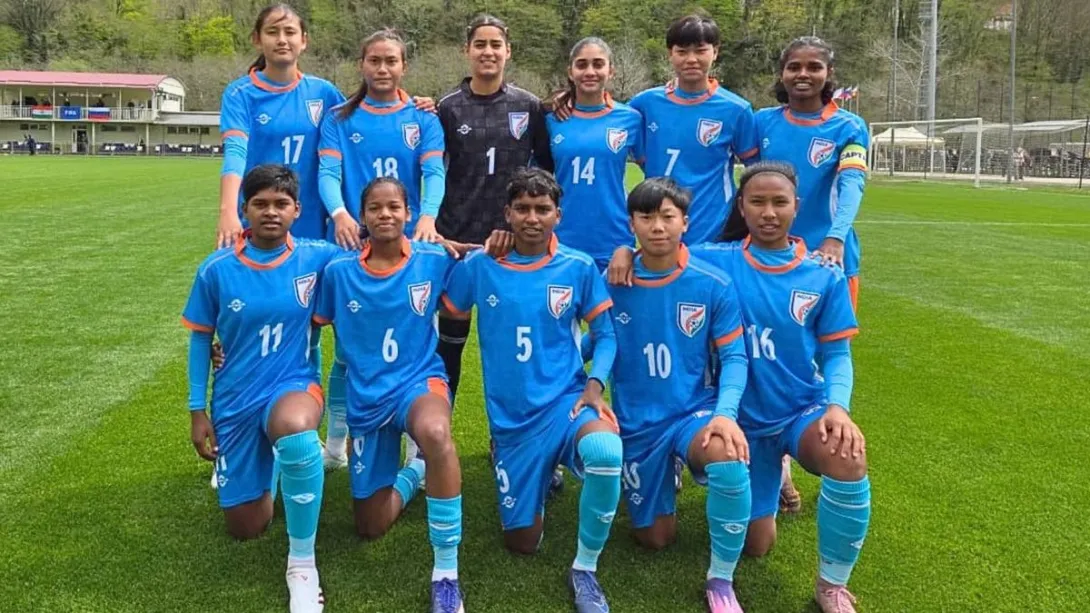
India’s Under-17 women’s football team encountered a difficult challenge in Sochi, registering a 0–3 loss against Russia in the second match of a three-game friendly series. The contest highlighted both the developmental progress and the competitive gap between the two sides. Russia’s clinical execution, including an early first-half goal and two rapid strikes after the interval, proved decisive. For India, the fixture served as a crucial preparatory exercise ahead of the AFC U-17 Women’s Asian Cup in China. Beyond the result, the match offered valuable insights into tactical discipline, defensive resilience, and the evolving demands of international youth football.
Match Overview: Russia’s Clinical Edge
India’s U-17 women’s squad faced a technically proficient Russian side that demonstrated composure and efficiency throughout the encounter. Russia opened the scoring in the 18th minute through Sofia Svyatnaya, who capitalized on defensive uncertainty to give the hosts an early advantage.
Despite attempts to regain control, India struggled to assert sustained possession or create high-quality chances in the attacking third. The first half ended with Russia maintaining a firm grip on the tempo and territorial advantage.
Decisive Moments After the Break
The match effectively slipped away from India in the early stages of the second half. Valeria Menyailova delivered a decisive blow with two quick goals in the 49th and 52nd minutes, exploiting gaps in India’s defensive structure.
These back-to-back strikes underscored the importance of concentration and adaptability at the international level. While India showed determination, the inability to respond swiftly to Russia’s attacking bursts proved costly.
Developmental Context and Strategic Importance
Under the stewardship of head coach Pamela Conti, the Indian team is engaged in a broader developmental cycle aimed at enhancing competitiveness on the continental stage. The ongoing three-match series in Sochi is a deliberate strategic initiative designed to expose players to high-intensity international football.
Such fixtures are critical from a performance analytics perspective. They allow coaching staff to evaluate tactical frameworks, assess player decision-making under pressure, and identify structural inefficiencies that may not surface in domestic competitions.
Lessons, Gaps, and Forward Strategy
From a strategic standpoint, the loss provides a data-rich environment for introspection. Defensive cohesion, transitional play, and finishing precision remain key areas for improvement. The experience also highlights the necessity of investing in youth development systems to bridge the competitive gap with established footballing nations.
As the team prepares for the AFC U-17 Women’s Asian Cup, the focus will likely shift toward refining defensive organization and improving attacking conversion rates. These adjustments are essential not only for immediate performance but also for long-term growth in women’s football.
Looking Ahead
With one match remaining in the series, India has an opportunity to recalibrate and demonstrate tactical evolution. While the scoreboard reflects a clear defeat, the broader narrative is one of learning, adaptation, and incremental progress.
In the larger context of Indian football’s growth trajectory, such international exposures represent a vital investment—one that, if leveraged effectively, could yield significant returns in future global competitions.
Comments