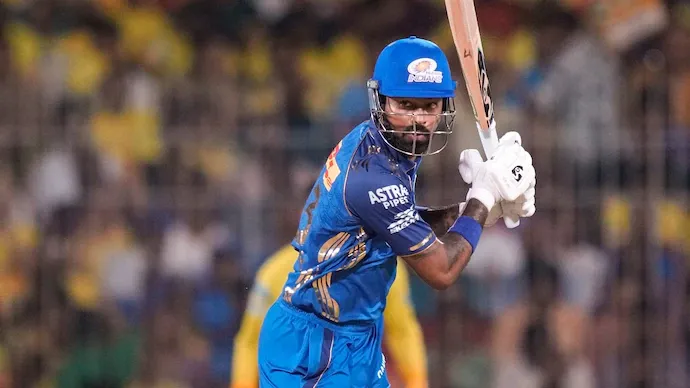
Former India captain and selector Kris Srikkanth delivered a scathing assessment of Mumbai Indians skipper Hardik Pandya following the franchise’s defeat to Chennai Super Kings at Chepauk. Srikkanth questioned Hardik’s leadership credentials and batting intent during a critical phase of the chase, describing him as a “plastic captain” in comments that have intensified scrutiny around Mumbai’s inconsistent IPL 2026 campaign. The criticism emerged after Hardik arrived at the crease at No. 6 following Tilak Varma’s dismissal while Naman Dhir was still well-set. As Mumbai Indians battle to remain relevant in the playoff race, the controversy has reignited wider discussions surrounding leadership, accountability, and tactical execution in modern franchise cricket.
Srikkanth Launches Blunt Attack on Hardik Pandya
Former India cricketer Kris Srikkanth triggered fresh controversy in IPL 2026 after publicly criticizing Mumbai Indians captain Hardik Pandya following the team’s defeat against Chennai Super Kings at the MA Chidambaram Stadium.
Srikkanth’s remarks focused heavily on Hardik’s approach during Mumbai’s run chase, with the former selector questioning both the player’s batting intent and overall captaincy style. His description of Hardik as a “plastic captain” quickly became one of the most discussed talking points in cricket circles, adding another layer of pressure to Mumbai’s already turbulent campaign.
The criticism reflected growing frustration among former players and analysts regarding Mumbai Indians’ inability to maintain consistency despite possessing one of the tournament’s most high-profile squads.
At a time when the franchise is fighting to stay competitive in the playoff race, public scrutiny surrounding leadership decisions has intensified considerably.
Batting Decisions Come Under the Spotlight
The controversy centered around a crucial phase of Mumbai Indians’ innings during the chase against Chennai Super Kings.
Hardik Pandya arrived at the crease at No. 6 immediately after Tilak Varma’s dismissal, with Mumbai still requiring stability and acceleration to remain in contention. At that stage, Naman Dhir had established himself at the crease and appeared capable of guiding the innings deeper into the contest.
Srikkanth questioned the urgency and intent displayed by Hardik during this period, suggesting that the Mumbai captain failed to impose pressure on Chennai’s bowling attack when the situation demanded proactive leadership.
In T20 cricket, momentum often shifts within a few overs, making batting tempo and decision-making critical during run chases. Captains are frequently expected to set the emotional tone of the innings, particularly under pressure in away fixtures against elite opposition.
Hardik’s innings therefore became symbolic of broader concerns regarding Mumbai’s execution during defining moments this season.
Mumbai Indians Continue to Struggle for Stability
Mumbai Indians’ IPL 2026 campaign has been marked by inconsistency, tactical uncertainty, and fluctuating performances.
Despite flashes of brilliance from individual players, the franchise has struggled to establish sustained momentum across consecutive matches. Several defeats have exposed recurring issues surrounding middle-order stability, bowling execution, and decision-making under pressure.
The leadership transition itself has remained a sensitive topic throughout the season. Hardik Pandya’s appointment as captain placed him in one of the most scrutinized roles in franchise cricket, particularly given Mumbai’s historic success under Rohit Sharma.
As a result, every tactical move and batting performance has attracted disproportionate public attention.
While leadership criticism is not uncommon in the IPL, the intensity surrounding Hardik’s captaincy reflects the enormous expectations attached to Mumbai Indians as one of the league’s most commercially powerful and historically successful teams.
Leadership in Modern T20 Cricket Under Constant Examination
Srikkanth’s comments also reflect a broader evolution in how leadership is evaluated in modern franchise cricket.
Captains are now judged not only by match results but also by visible intent, body language, tactical aggression, and emotional influence over teammates. Public perception increasingly shapes leadership narratives, particularly in tournaments as commercially visible as the IPL.
In Hardik Pandya’s case, criticism has often focused on whether his on-field demeanor reflects urgency during high-pressure situations. Supporters argue that he remains an aggressive competitor capable of delivering match-winning performances, while critics believe Mumbai Indians have occasionally appeared tactically passive during key moments.
This divide in opinion illustrates how modern cricket leadership is no longer assessed purely through statistics but also through broader perceptions of authority and composure.
Srikkanth’s Remarks Highlight IPL’s Expanding Media Ecosystem
The strong reaction to Srikkanth’s criticism also underlines the increasingly influential role former players and commentators play in shaping IPL narratives.
With social media, digital broadcasting, and 24-hour sports analysis dominating modern cricket coverage, public criticism now travels rapidly and often influences wider fan sentiment.
High-profile former cricketers such as Srikkanth carry significant credibility among audiences, meaning their assessments frequently shape discussions surrounding players and franchises.
For Mumbai Indians, such commentary adds further external pressure during an already delicate stage of the season.
The franchise’s management will likely focus on maintaining dressing-room stability while attempting to ensure that criticism from outside does not affect internal morale or performance levels.
Hardik Pandya Faces Crucial Phase in Captaincy Journey
IPL 2026 is increasingly becoming an important test of Hardik Pandya’s long-term leadership trajectory.
His earlier success as captain of Gujarat Titans established him as one of Indian cricket’s most promising modern leaders, admired for fearless tactics and calmness in high-pressure situations. However, leading Mumbai Indians presents a very different challenge due to the scale of expectations, legacy pressure, and constant public attention attached to the franchise.
Captaining a dressing room filled with established stars requires both tactical clarity and emotional authority — qualities that are continuously evaluated during difficult periods.
The remainder of the season could therefore significantly influence broader perceptions surrounding Hardik’s future as a franchise leader and potential long-term leadership option in Indian cricket.
Pressure Builds as IPL 2026 Approaches Its Final Stretch
As the IPL playoff race intensifies, scrutiny surrounding leadership decisions is expected to grow even stronger.
For Mumbai Indians, the immediate priority remains restoring consistency and reviving momentum before qualification scenarios become mathematically difficult. However, the broader narrative surrounding Hardik Pandya’s captaincy now forms an unavoidable backdrop to the campaign.
Whether Srikkanth’s criticism proves temporary or becomes part of a larger conversation regarding Mumbai’s leadership direction will depend largely on performances in the coming weeks.
In the IPL’s high-pressure ecosystem, victories often silence criticism quickly. Defeats, however, tend to magnify every unresolved question.
Comments