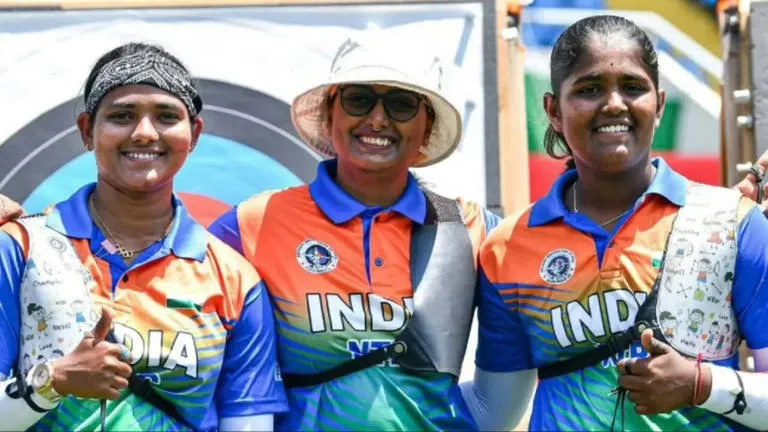
India’s women’s recurve archery team produced a landmark performance at the Archery World Cup 2026 Stage 2 in Shanghai, defeating host nation China 28-26 in a dramatic final to secure the gold medal. The trio of Deepika Kumari, Ankita Bhakat, and teenage prodigy Kumkum Mohod displayed remarkable composure under pressure, overcoming both a hostile home crowd and two of the sport’s traditional powerhouses. India’s campaign gained global attention after the team eliminated South Korea in the semifinal before overcoming China in the title clash. The victory marks a significant moment for Indian archery, highlighting the nation’s growing competitiveness and strengthening its position among the world’s elite recurve programs.
India Claims Prestigious World Cup Gold
India’s women’s recurve archery team achieved a major international breakthrough by clinching the gold medal at the Archery World Cup Stage 2 in Shanghai. In a high-pressure final contested against host China, the Indian side emerged victorious with a narrow 28-26 scoreline, delivering one of the country’s most memorable performances in modern recurve archery.
The championship-winning lineup featured veteran archer Deepika Kumari, established international competitor Ankita Bhakat, and 17-year-old rising star Kumkum Mohod. Together, the trio combined experience, tactical precision, and mental resilience to secure victory against one of the sport’s strongest nations on its home turf.
The result represents a substantial achievement for Indian archery, not only because of the gold medal itself but also because of the caliber of opponents defeated during the tournament.
Pressure, Precision, and a Historic Final
The gold-medal contest unfolded in front of an energized home crowd in Shanghai, where China entered the final with expectations of securing victory on familiar ground. However, the Indian team maintained composure throughout the tense encounter, executing critical shots with consistency during decisive moments.
International recurve archery is often determined by marginal differences in concentration and execution, particularly in knockout rounds where momentum can shift rapidly. India’s ability to remain calm under sustained pressure highlighted the maturity and discipline within the squad.
The narrow margin of victory reflected the intensity of the contest, with both teams producing high-quality performances. Yet India’s archers demonstrated superior nerve in the closing stages, ultimately securing a result that could become a defining moment for the national program.
Semifinal Victory Over South Korea Signals a Power Shift
Before overcoming China in the final, India produced another major statement by defeating South Korea in the semifinal.
South Korea has historically dominated international recurve archery, establishing itself as the benchmark nation across Olympic and World Cup competitions. Any victory against the Korean setup is considered a significant accomplishment within the sport.
India’s semifinal triumph demonstrated that the gap between traditional archery powerhouses and emerging contenders is steadily narrowing. More importantly, it showcased India’s ability to compete consistently against elite opposition across multiple high-pressure matches.
Analysts are likely to interpret the result as evidence of the growing sophistication of India’s training systems, athlete preparation, and international competitiveness.
Kumkum Mohod Emerges as a Future Star
One of the tournament’s most compelling narratives was the emergence of 17-year-old Kumkum Mohod, who delivered a composed performance despite competing on one of the biggest stages of her young career.
Teenage athletes often face enormous psychological challenges in elite international competition, particularly in precision sports where emotional stability plays a decisive role. Mohod’s confidence and technical consistency suggested a level of maturity rarely seen at such an early stage.
Her contribution also reflected the increasing depth of India’s archery talent pool. The integration of young athletes alongside experienced performers such as Deepika Kumari indicates a long-term strategy focused on sustainable international success.
If nurtured effectively, Mohod could become one of the central figures in India’s next generation of global archery talent.
Deepika Kumari’s Leadership Remains Crucial
The Shanghai triumph once again underlined the enduring significance of Deepika Kumari within Indian archery. Having spent years competing at the highest level, Kumari brought valuable experience and strategic stability to the team during crucial moments.
Elite tournaments are often shaped not only by technical accuracy but also by leadership and emotional control. Kumari’s presence provided assurance to the younger members of the squad, helping maintain composure in a hostile competitive environment.
Her continued success also demonstrates the importance of experienced athletes in guiding transitional phases within national sporting structures, particularly as emerging talent begins to enter the senior international circuit.
A Turning Point for Indian Archery
India’s success in Shanghai extends beyond a single tournament victory. The performance reflects broader progress within the country’s sporting ecosystem, where increased investment, professional coaching structures, and international exposure are beginning to yield consistent results.
Archery has long been viewed as a discipline with enormous untapped potential in India. However, competing consistently against nations such as China and South Korea has historically remained a formidable challenge.
This World Cup triumph signals that India is no longer merely capable of isolated upsets but is increasingly establishing itself as a credible and sustained contender in global recurve competition.
The achievement is also expected to generate greater public interest and institutional support for the sport, factors that remain critical for long-term development.
Momentum Builds Ahead of Future International Events
The gold medal victory in Shanghai could serve as a pivotal confidence boost for India’s women’s recurve program ahead of upcoming international competitions. Winning against elite opponents in high-pressure environments often creates momentum that extends well beyond a single event.
For India’s archers, the tournament validated both their technical capabilities and psychological readiness at the highest level of competition. It also reinforced the belief that Indian teams can challenge established powers consistently on the global stage.
As international archery becomes increasingly competitive, India’s performance in Shanghai may ultimately be remembered as a moment that accelerated the nation’s transformation from promising challenger to genuine world-class force.
Comments