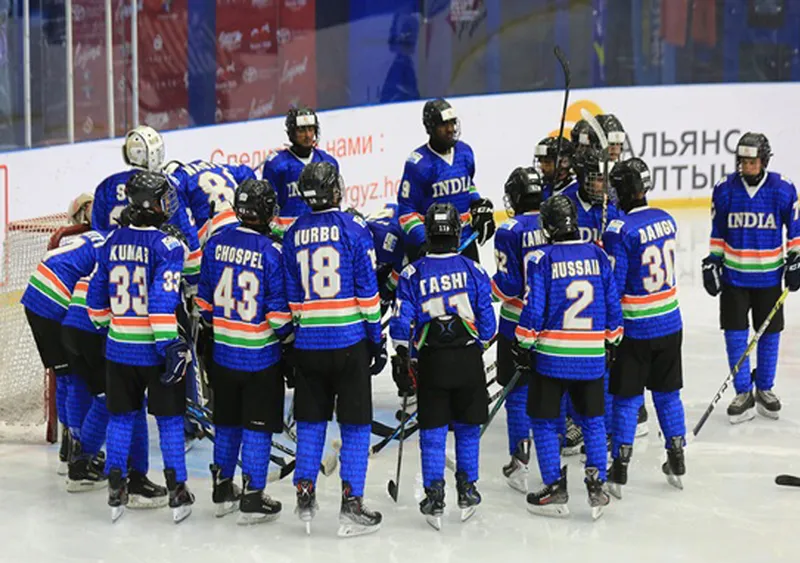
India’s under-18 ice hockey team delivered a resounding 8–1 victory over Macau at the Asia Cup in Bishkek, underlining the country’s growing capabilities in winter sports. Led by captain Gurtej Singh Bhatti, who scored four goals, the team demonstrated tactical cohesion, attacking efficiency, and sustained dominance across all three periods. The performance reflects broader institutional progress in developing non-traditional sports in India. As the nation seeks to diversify its global sporting footprint, such victories highlight the potential for long-term growth, increased investment, and enhanced international competitiveness.
A Dominant Display on the Continental Stage
India’s U-18 ice hockey team produced a commanding performance to defeat Macau 8–1, establishing early control and maintaining authority throughout the match. The team’s aggressive start set the tone, allowing it to build a decisive lead in the opening phase itself.
Ajay Dangi initiated the scoring, providing India with early momentum. From there, the side executed a well-coordinated offensive strategy, consistently pressuring the opposition and capitalizing on scoring opportunities.
The ability to sustain intensity across all three periods reflects a high level of physical conditioning and tactical discipline, attributes essential for success in competitive international tournaments.
Leadership and Offensive Excellence
At the core of India’s victory was the standout performance of captain Gurtej Singh Bhatti, whose four goals underscored his attacking prowess and leadership credentials. His performance not only widened the scoreline but also reinforced team confidence during critical phases of the game.
Additional contributions from Itfiqar Hussain, Tanzin Tashi, and Devansh Sharma highlighted the squad’s depth and balanced offensive capabilities.
Bhatti emphasized post-match that the team’s structured approach and in-game adaptability were key factors behind the comprehensive win, particularly their ability to reassess strategies and respond effectively in the final period.
Tactical Maturity and Game Management
Beyond individual brilliance, India’s performance was defined by disciplined execution and strategic clarity. The team maintained possession efficiently, minimized defensive vulnerabilities, and demonstrated a keen understanding of game tempo.
A notable aspect was the squad’s mid-game recalibration, which allowed it to elevate performance in the third period. This level of tactical maturity at the junior level reflects the positive impact of structured training programs and increased exposure to international competition.
Such attributes are indicative of a maturing sporting ecosystem, where preparation and analytics are becoming as critical as raw talent.
Institutional Support and Development Trajectory
The victory drew praise from Harjinder Singh, General Secretary of the Ice Hockey Association of India, who acknowledged the team’s progress and growing competitiveness on the global stage.
This recognition underscores the role of institutional backing in nurturing talent and expanding the reach of winter sports in India. Increased focus on grassroots development, infrastructure, and international exposure is gradually translating into tangible results.
Broader Economic and Strategic Implications
While ice hockey remains a niche sport within India’s broader athletic framework, performances of this scale carry meaningful economic and strategic implications. Success at international tournaments enhances visibility, potentially attracting sponsorship deals, government funding, and private investment.
From a business perspective, diversification into emerging sports aligns with India’s ambition to broaden its sports economy. As global interest in varied disciplines grows, even niche segments can evolve into commercially viable markets with the right support and sustained success.
Conclusion: A Win That Reflects a Larger Shift
India’s emphatic victory over Macau is more than a statistical success—it is a reflection of a shifting paradigm in Indian sports. With disciplined execution, strong leadership, and growing institutional support, the U-18 team has demonstrated that India can compete effectively beyond traditional sporting domains.
As the tournament progresses, maintaining consistency will be crucial. However, this performance has already positioned India as a rising contender in Asian ice hockey, signaling a future where emerging sports play a more prominent role in the nation’s athletic and economic narrative.
Comments