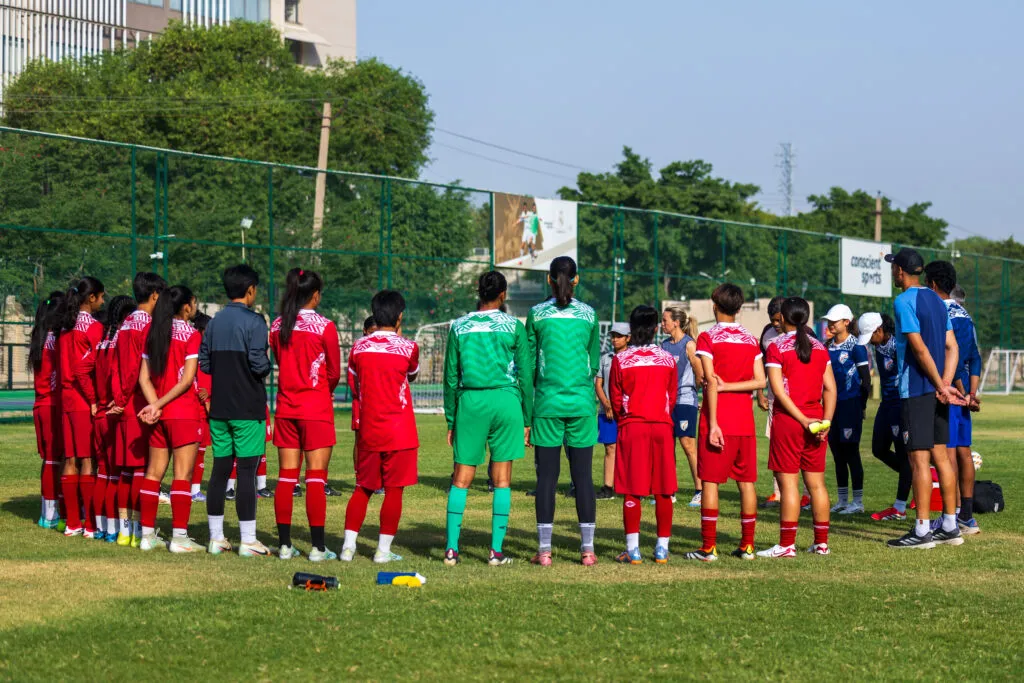
India’s Under-17 women’s football team has landed in China to compete in the AFC U17 Women’s Asian Cup 2026, marking its first appearance in the tournament in over two decades. The campaign represents a critical milestone in India’s long-term football development strategy, particularly in the women’s segment. With a demanding group stage featuring top Asian sides, the tournament offers both a competitive test and a platform for talent exposure. Backed by months of structured training, international friendlies, and recent regional success, the team’s participation underscores a renewed institutional focus on building sustainable pathways in women’s football.
A Landmark Return to Continental Football
The India women's national under-17 football team has arrived in Suzhou on April 27, signaling a historic return to the AFC U17 Women’s Asian Cup China 2026 after a 21-year absence.
This re-entry into elite Asian competition reflects a broader recalibration within Indian football, where governing bodies are increasingly prioritizing youth development and international exposure as foundational pillars for long-term success.
Group Stage: A Test of Competitive Maturity
India has been drawn into a challenging Group B, facing Australia women's national under-17 football team, Japan women's national under-17 football team, and Lebanon women's national under-17 football team.
All matches will be played at the Suzhou Taihu Football Sports Centre, a venue designed to host high-level international fixtures. The group composition presents a formidable challenge, particularly given the technical pedigree of Japan and the physical intensity associated with Australia’s playing style.
Preparation Framework: Investment in Human Capital
Under head coach Pamela Conti, the team has undergone a rigorous preparation cycle spanning more than three months. The primary training base in Bengaluru was complemented by a focused camp in Gurugram.
This structured approach reflects a shift toward systematic talent development, where training is aligned with international benchmarks. Emphasis has been placed on tactical cohesion, fitness optimization, and psychological readiness—key determinants of performance at elite levels.
International Exposure and Competitive Momentum
To enhance match readiness, the squad participated in international friendlies against Myanmar women's national under-17 football team and Russia women's national under-17 football team. These fixtures provided critical exposure to varied tactical systems and competitive environments.
The team also enters the tournament with a confidence boost, having secured the SAFF U19 Women’s Championship title earlier this year. Such achievements not only validate the training framework but also strengthen team morale ahead of tougher international contests.
Broader Strategic Implications
From a policy and investment perspective, India’s participation in the AFC U17 Women’s Asian Cup China 2026 represents a calculated step toward expanding its footprint in women’s football. Youth competitions function as critical incubators, shaping future senior-level athletes and enhancing the sport’s commercial ecosystem.
As global interest in women’s sports accelerates, early-stage investments in talent development can yield substantial returns—both in terms of international performance and marketability.
Conclusion
India’s return to the continental stage is as much about rebuilding credibility as it is about competing for results. While the immediate challenge lies in navigating a demanding group, the larger narrative centers on long-term growth and structural evolution.
As matches unfold in Suzhou, the Young Tigresses carry the dual responsibility of performance and representation. Their journey may well serve as a benchmark for the future trajectory of women’s football in India.
Comments