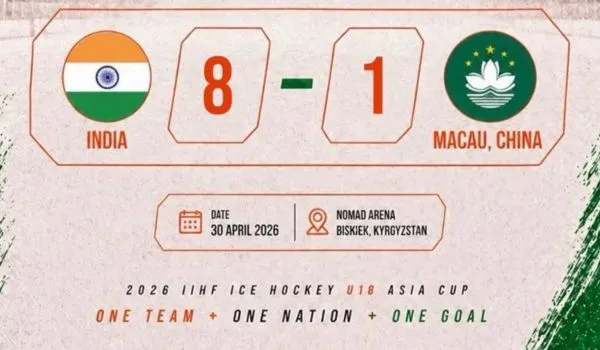
India U-18 Ice Hockey Team recorded a decisive 8-1 victory against Macau U-18 Ice Hockey Team in the Under-18 Asia Cup in Bishkek, marking its first win of the tournament. Following early setbacks against Indonesia and Uzbekistan, the Indian side demonstrated notable tactical improvement, combining offensive efficiency with defensive discipline. Captain Gurtej Singh Bhatti led with four goals, reinforcing his status as a leading scorer. The performance highlights resilience, strategic recalibration, and the growing maturity of India’s youth ice hockey program within an emerging competitive landscape.
Match Overview: A Comprehensive Turnaround
India’s emphatic victory represents a critical inflection point in its tournament campaign. Entering the match under pressure after consecutive defeats, the team responded with a performance defined by clarity, cohesion, and execution.
The 8-1 scoreline reflects not only attacking dominance but also improved defensive organization. From the outset, India controlled the pace of the game, limiting Macau’s opportunities while capitalizing efficiently on scoring chances.
Leadership Impact: Bhatti’s Commanding Performance
Captain Gurtej Singh Bhatti delivered a standout performance, scoring four goals with precision and composure. His contribution extended beyond scoring, providing leadership that galvanized the team’s overall effort.
In youth tournaments, such leadership often plays a pivotal role in shaping outcomes. Bhatti’s ability to perform under pressure underscores his growing influence and reinforces his position among the competition’s top performers.
Collective Execution: Depth in Attack
While Bhatti’s performance was central, the victory was built on collective contribution. Goals from Devansh, Ajay Dangi, Tashi, and Iftiqar Hussain highlighted the team’s offensive depth and improved coordination.
This balanced scoring distribution signals a shift toward a more sustainable performance model, reducing reliance on individual brilliance and enhancing overall team resilience.
Tactical Evolution: Learning from Early Setbacks
India’s earlier losses exposed structural weaknesses, particularly in defensive transitions and puck control. Against Macau, these areas showed marked improvement.
The team demonstrated better spacing, sharper passing, and more effective transitions between attack and defense. Such adjustments reflect a capacity for rapid learning—an essential trait in both sport and high-performance organizational environments.
Psychological Resilience: Rebuilding Momentum
The importance of this victory extends beyond immediate points. Recovering from early defeats requires mental resilience, especially in a competitive tournament setting.
By delivering a dominant performance, India has re-established confidence and momentum. This psychological shift can influence subsequent matches, creating a foundation for sustained improvement.
Strategic and Developmental Implications
India’s performance in the Under-18 Asia Cup highlights the gradual evolution of ice hockey within the country. Success at the youth level is critical for building a long-term talent pipeline and attracting investment into the sport.
From a broader perspective, such results contribute to the sport’s visibility and potential commercialization, aligning with strategic growth objectives in emerging sporting sectors.
Conclusion: A Defining Moment in the Campaign
India’s 8-1 victory over Macau stands as its most complete performance of the tournament, combining tactical discipline, leadership, and collective execution.
As the competition progresses, the challenge will be to sustain this level of performance and convert momentum into consistent results. In both sport and business, the ability to adapt, respond, and execute under pressure remains the cornerstone of long-term success—and India has taken a significant step forward.
Comments