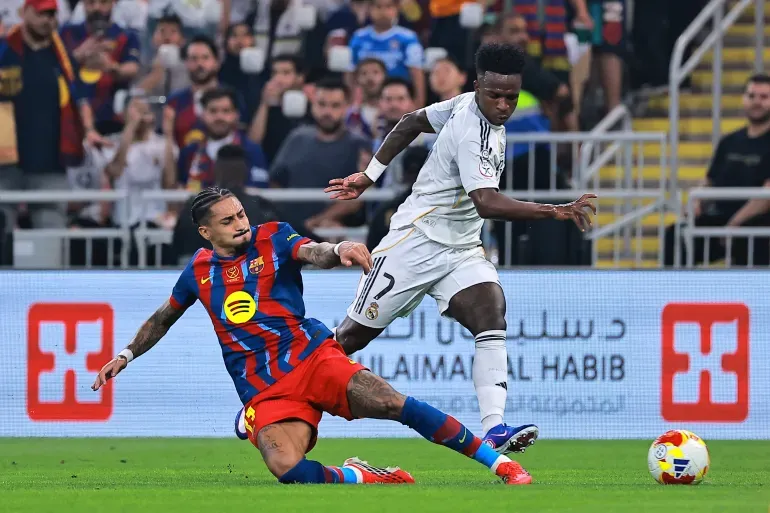
The football world will once again turn its attention toward Spain as FC Barcelona and Real Madrid CF prepare for the 264th edition of El Clasico in a decisive La Liga showdown on Sunday. The encounter arrives under extraordinary circumstances, with Barcelona standing on the brink of a league triumph while a struggling and emotionally wounded Real Madrid side confronts the possibility of seeing their greatest rivals celebrate domestic supremacy. Beyond the title implications, the match represents a broader clash of institutional prestige, sporting identity, and commercial influence. As pressure intensifies around both clubs, the latest El Clasico promises to become one of the defining moments of the European football season.
El Clasico Returns With Historic Stakes
Few fixtures in global sport command the emotional, commercial, and cultural influence of El Clasico, and Sunday’s encounter between FC Barcelona and Real Madrid CF arrives with unusually high tension surrounding both clubs.
The 264th meeting between Spain’s two footballing superpowers could significantly shape the outcome of the La Liga title race while simultaneously influencing the broader narratives surrounding the future direction of each institution.
Barcelona enter the contest with momentum, confidence, and the opportunity to edge closer to another domestic championship. Real Madrid, meanwhile, travel to Catalonia carrying the psychological burden of inconsistency and the possibility of witnessing their fiercest rivals strengthen their dominance on one of football’s grandest stages.
The emotional contrast between the two camps has transformed this Clasico into far more than a routine league fixture.
Barcelona Seek Validation of Their Sporting Revival
For FC Barcelona, Sunday’s match represents a pivotal opportunity to validate the club’s broader sporting and institutional recovery.
In recent years, Barcelona have navigated significant financial instability, structural uncertainty, and transitional challenges both on and off the pitch. Despite those setbacks, the club has gradually rebuilt its competitive identity through tactical evolution, youth development, and strategic restructuring.
A victory over Real Madrid at this stage of the season would symbolize far more than three points. It would reinforce Barcelona’s return to domestic supremacy while strengthening confidence in the club’s long-term sporting project.
From a business perspective, securing the league title would also provide substantial commercial advantages. Success at the highest level enhances sponsorship value, global marketability, broadcasting leverage, and overall institutional stability — critical factors in modern football’s increasingly competitive economic environment.
Real Madrid Face Pressure Beyond the Scoreline
For Real Madrid CF, the Clasico arrives during a period of mounting scrutiny and emotional fatigue.
The Madrid giants, historically synonymous with dominance and resilience, have endured growing criticism over recent performances and overall consistency. Entering a decisive Clasico under such circumstances creates enormous psychological pressure, particularly given the possibility of Barcelona moving closer to the title in front of their home supporters.
At Real Madrid, expectations are uniquely unforgiving. Every defeat becomes magnified by the club’s historic stature and global audience, while every setback invites questions regarding leadership, squad structure, and tactical direction.
Sunday’s encounter therefore represents not only an opportunity to disrupt Barcelona’s celebrations but also a crucial test of Madrid’s collective mentality and competitive resilience.
Tactical Battle Could Define the Match
As has often been the case throughout the history of El Clasico, tactical discipline may ultimately determine the outcome.
Barcelona are expected to rely heavily on structured possession football, midfield control, and aggressive pressing systems designed to dictate tempo and territorial dominance. Their emphasis on positional organization has become increasingly effective during the current campaign.
Real Madrid, by contrast, may focus on transition-based football and moments of individual brilliance. Historically, Madrid have often succeeded in high-pressure Clasicos by exploiting open spaces and capitalizing on emotional volatility within matches.
The strategic battle between the two coaching staffs will likely prove decisive. In elite football, especially in fixtures carrying championship implications, marginal tactical adjustments frequently separate triumph from disappointment.
El Clasico’s Global Commercial Influence Continues to Grow
Beyond its sporting significance, El Clasico remains one of the most commercially valuable fixtures in international sport.
The rivalry between FC Barcelona and Real Madrid CF consistently generates enormous global television audiences, sponsorship engagement, digital interaction, and merchandising revenue.
Modern football clubs increasingly function as multinational entertainment brands, and matches of this scale serve as critical commercial showcases. Every Clasico influences brand positioning, fan engagement metrics, international sponsorship negotiations, and long-term market expansion strategies.
This commercial reality adds another layer of pressure to an already emotionally charged rivalry. Success in El Clasico impacts not only league standings but also institutional prestige within the global sports economy.
Catalonia Braces for Electrifying Atmosphere
The atmosphere in Catalonia is expected to be among the most intense seen in recent Clasico history.
Barcelona supporters recognize the symbolic importance of potentially moving closer to the La Liga title against their greatest rivals. The emotional energy surrounding the fixture is likely to create an intimidating environment for the visiting Madrid players from the opening moments of the match.
Managing that atmosphere will become a major psychological challenge for Real Madrid. Elite clubs are often judged by their ability to respond under hostile conditions, particularly during moments of collective adversity.
How Madrid cope emotionally may ultimately prove just as important as their tactical execution on the pitch.
More Than a Match, a Defining Moment
El Clasico has always existed beyond the boundaries of football itself. The rivalry embodies decades of sporting excellence, political symbolism, cultural identity, and institutional power.
Sunday’s encounter arrives at a particularly significant moment for both clubs. Barcelona view the match as an opportunity to reinforce their resurgence and reclaim domestic supremacy with authority. Real Madrid see it as a chance to resist decline, restore confidence, and disrupt the momentum of their historic rivals.
Whatever the result, the 264th edition of El Clasico promises to deliver another emotionally charged chapter in one of the most influential rivalries in the history of global sport.
Comments