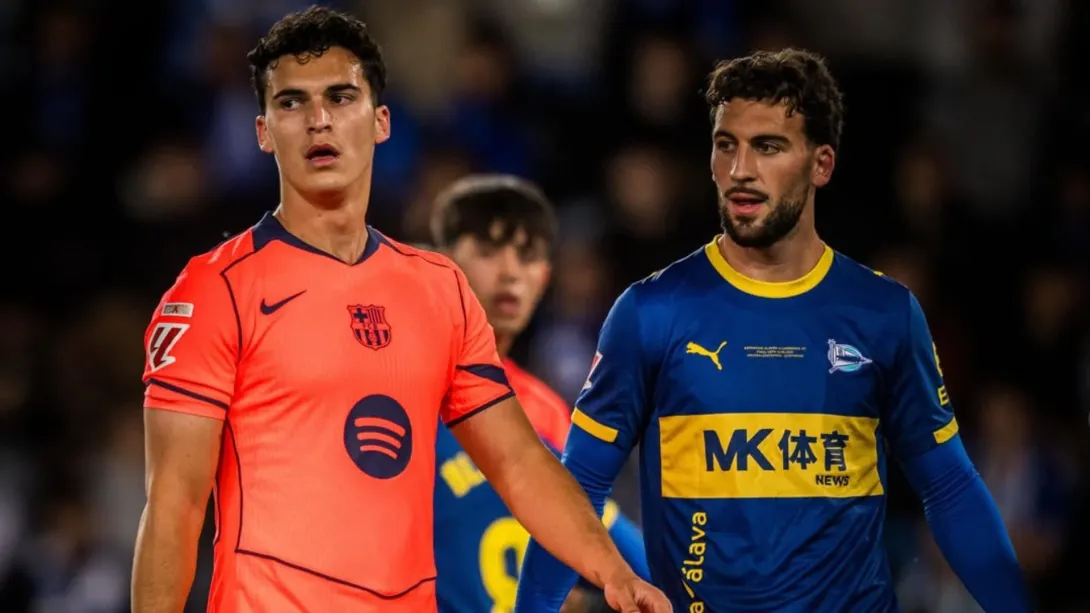
Hansi Flick appears to have identified another promising academy talent capable of contributing to FC Barcelona’s evolving first-team structure following the strong debut of Alvaro Cortes against Deportivo Alavés. Reports from Spanish media indicate the Barcelona manager was particularly impressed with the young centre-back’s composure, positioning, and maturity under pressure. As a result, Cortes is now expected to be included in the club’s pre-season plans for next season. The development reinforces Barcelona’s renewed commitment to academy-driven squad building as the club balances financial discipline, competitive ambitions, and long-term structural rebuilding.
Flick Continues to Prioritize Emerging Talent
The early phases of Hansi Flick’s tenure at FC Barcelona are increasingly revealing a clear managerial pattern: a willingness to trust technically disciplined young players capable of adapting to elite-level tactical systems.
That philosophy appears to have benefited Alvaro Cortes, whose recent first-team appearance against Deportivo Alavés reportedly exceeded internal expectations.
Spanish reports suggest Flick was highly encouraged by the defender’s calm decision-making, defensive awareness, and ability to maintain positional discipline despite the pressures associated with senior-level football.
The positive impression has reportedly elevated Cortes into Barcelona’s projected pre-season squad ahead of next season, signaling growing confidence in the youngster’s developmental trajectory.
Barcelona’s Academy Model Returns to Strategic Importance
The rise of another academy player comes at a critical moment for Barcelona, both financially and competitively.
Following years of financial instability and restructuring, the club has increasingly prioritized internal player development as a sustainable alternative to expensive transfer-market activity. Promoting academy graduates not only reduces financial pressure but also reinforces Barcelona’s traditional football identity built around technical education and tactical intelligence.
Within that context, the progression of Alvaro Cortes represents more than a routine youth promotion. It reflects a broader institutional effort to rebuild squad depth through long-term talent cultivation rather than short-term spending.
Analysts believe Barcelona’s future competitiveness may depend heavily on the club’s ability to consistently integrate academy products into the senior structure while maintaining elite performance standards.
Flick’s Tactical System Rewards Intelligent Defenders
Hansi Flick has historically favored defenders capable of combining technical comfort with tactical discipline — a profile that appears aligned with Cortes’ early attributes.
The German coach is widely recognized for implementing structured defensive systems that demand intelligent positioning, quick transitions, and composure during high-pressure phases of play. Young defenders entering such systems are often evaluated not only on physical ability but also on game intelligence and adaptability.
Observers believe Cortes’ mature performance against Alavés may have strengthened confidence within the coaching staff that he can eventually operate within Flick’s demanding tactical framework.
For Barcelona, identifying defensively reliable academy prospects remains strategically valuable at a time when squad optimization and financial efficiency are closely interconnected.
Pre-Season Inclusion Seen as Significant Step
Reports suggesting that Alvaro Cortes is expected to join Barcelona’s pre-season preparations are being viewed internally as an important milestone in his development.
Pre-season tours often serve as crucial evaluation environments where coaching staff assess emerging players over an extended period against varied opposition and under intense tactical training conditions.
Inclusion in those plans does not necessarily guarantee immediate first-team integration, but it frequently signals that the player has entered the club’s medium-term competitive considerations.
For younger academy graduates, these opportunities can accelerate development by providing exposure to senior dressing-room standards, elite-level preparation methods, and direct interaction with established international players.
La Masia’s Enduring Influence on Barcelona’s Identity
The emergence of another defensive prospect also highlights the continuing importance of La Masia within Barcelona’s long-term sporting philosophy.
Widely regarded as one of world football’s most influential development academies, La Masia has historically produced generations of players who shaped not only Barcelona’s success but also modern positional football itself.
Although Barcelona experienced periods of aggressive external recruitment in previous years, recent financial realities have pushed the club toward rediscovering the value of internal development pathways.
The organization’s renewed focus on youth integration suggests Barcelona is attempting to restore a model where academy progression becomes central to both sporting continuity and economic sustainability.
A Long-Term Rebuilding Strategy Takes Shape
Barcelona’s current trajectory increasingly reflects a club attempting to balance short-term competitiveness with long-term structural repair.
Rather than relying exclusively on high-profile acquisitions, the club appears committed to building a more financially sustainable roster through a combination of experienced leadership and carefully developed young talent.
In that environment, the emergence of Alvaro Cortes may ultimately symbolize more than a successful debut. It could represent another important step in Barcelona’s broader rebuilding process under Hansi Flick.
As the club prepares for the upcoming season, the continued integration of academy players may prove essential not only to Barcelona’s sporting ambitions but also to its long-term institutional stability.
Comments