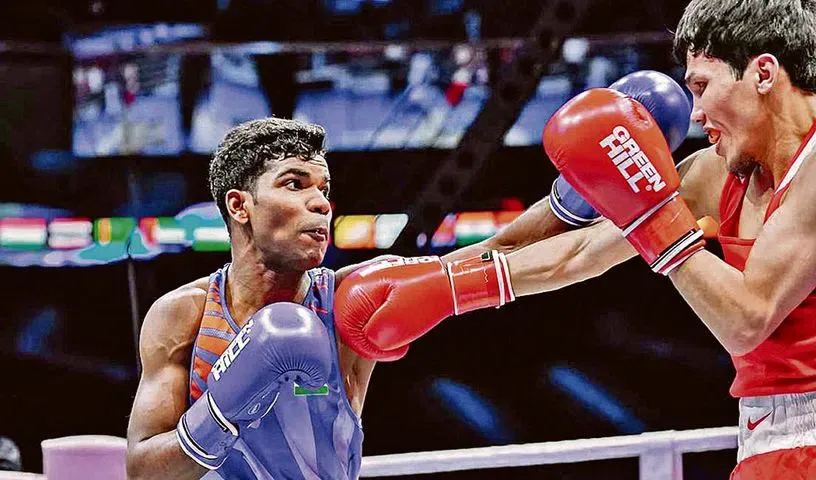
India’s Vishvanath Suresh delivered a breakthrough performance at the Asian Boxing Championships, defeating a reigning world champion in a result that reverberates beyond the ring. The upset underscores India’s growing competitiveness in international boxing, driven by structured training systems and increased financial investment. Suresh’s tactical precision and composure exemplify a new generation of athletes benefiting from modern sports infrastructure. The victory not only elevates India’s standing in the sport but also enhances its commercial potential, signaling a shift toward a more diversified and economically viable sporting ecosystem.
A Defining Upset on the Asian Stage
Vishvanath Suresh’s triumph represents one of the most significant results in recent editions of the Asian Boxing Championships. Facing a decorated world champion, Suresh entered the bout as an underdog but quickly established control through disciplined execution.
His victory reflects the enduring appeal of boxing as a meritocratic sport, where preparation and strategy can overturn established hierarchies. For India, the result is emblematic of a broader transition toward global competitiveness.
Technical Mastery and Tactical Discipline
Suresh’s performance was anchored in technical clarity and tactical awareness. He effectively neutralized his opponent’s offensive strengths while capitalizing on counterattacking opportunities.
The bout showcased his ability to manage distance, maintain composure under pressure, and execute scoring combinations with precision. Such attributes are increasingly characteristic of Indian boxers, who are now benefiting from advanced coaching methodologies and data-driven performance analysis.
Investment Trends and Institutional Backing
India’s emergence in boxing is closely linked to sustained investment in sports infrastructure and athlete development. Funding from government bodies and private stakeholders—often amounting to several crores (Rs.)—has improved access to training facilities, international exposure, and sports science support.
These investments are beginning to yield measurable outcomes, with athletes like Suresh demonstrating the effectiveness of a system that prioritizes long-term development over short-term gains.
Commercial Potential and Market Expansion
High-profile victories on international platforms contribute to the commercialization of non-cricket sports in India. Boxing, in particular, stands to gain from increased visibility, attracting sponsorships, endorsements, and media attention.
Suresh’s win could act as a catalyst for broader market engagement, encouraging brands to invest in emerging sports properties. This aligns with a growing trend toward diversification within India’s sports economy, where multiple disciplines are vying for commercial relevance.
Strategic Implications for Indian Boxing
The psychological and strategic impact of defeating a world champion cannot be overstated. Such victories enhance confidence within the national contingent and establish benchmarks for future performance.
For Vishvanath Suresh, this result positions him as a serious contender in upcoming international competitions. For Indian boxing, it reinforces the viability of its development model and its potential to produce world-class athletes consistently.
Conclusion: A Victory Beyond the Ring
Vishvanath Suresh’s upset win is more than an isolated achievement—it is a reflection of systemic progress and strategic intent. As India continues to invest in sports beyond its traditional strongholds, such performances validate the long-term vision of building a diversified and competitive sporting ecosystem.
In the evolving landscape of global boxing, this victory stands as both a milestone and a signal of greater ambitions yet to be realized.
Comments