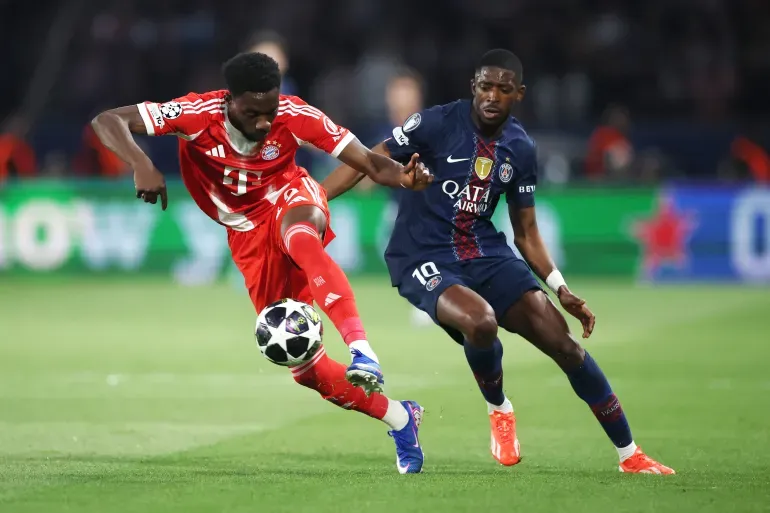
Paris Saint-Germain will travel to Munich holding a narrow 5-4 advantage over FC Bayern Munich in what promises to be one of the most anticipated UEFA Champions League semifinal second legs in recent memory. The first encounter produced a historic nine-goal thriller that became the highest-scoring semifinal first leg in the competition’s history. With both clubs committed to ultra-attacking football and managers refusing to adopt a conservative approach, expectations are building for another dramatic European showdown. Beyond the sporting spectacle, the tie also highlights the immense commercial power, global influence, and financial stakes attached to elite continental football in the modern era.
A Semifinal That Redefined European Drama
The UEFA Champions League has produced countless iconic matches across generations, but the first-leg encounter between Paris Saint-Germain and Bayern Munich instantly secured a place among the competition’s modern classics.
The game delivered extraordinary attacking football from the opening whistle, with defensive caution largely abandoned in favor of relentless offensive ambition. By the end of the night, PSG emerged with a slender 5-4 advantage after a contest that shattered records and captivated global audiences.
The match became the highest-scoring semifinal first leg in Champions League history, underlining both the attacking quality and tactical boldness displayed by the two European giants.
Analysts described the encounter as a reflection of modern elite football, where entertainment value, high pressing, and attacking intensity increasingly define the sport’s biggest occasions.
Now, with a place in the Champions League final at stake, attention shifts to Munich for what could become another unforgettable European night.
Managers Reject Defensive Football
Perhaps the most remarkable aspect of the semifinal has been the refusal of both managers to embrace caution despite the enormous stakes involved.
Traditionally, knockout football at this stage rewards tactical discipline and defensive structure. However, both PSG and Bayern have adopted an aggressive philosophy built around attacking transitions, vertical passing, and continuous pressure in advanced areas.
Several of world football’s premier attacking players were effectively given freedom to dictate the rhythm of the first leg, transforming the match into a relentless exchange of goals and counterattacks.
What makes the second leg even more intriguing is that both coaches have publicly indicated they intend to maintain the same attacking mindset rather than protect results conservatively.
That approach reflects not only confidence in their offensive systems, but also recognition of the realities of modern European football, where passive tactics can quickly become self-destructive against elite attacking opposition.
PSG Pursue the Defining Trophy of Their Modern Era
For Paris Saint-Germain, the semifinal represents another critical moment in the club’s long-term European project.
Over the past decade, PSG have invested heavily in building a squad capable of winning the Champions League — the one trophy that continues to define the club’s broader sporting legitimacy. Massive expenditures on transfers, wages, infrastructure, and global brand expansion have transformed the French side into one of football’s most commercially powerful institutions.
Yet despite domestic dominance, continental success has often remained elusive.
The current campaign has demonstrated a more tactically mature PSG side, combining attacking flair with greater structural balance. The narrow first-leg victory against Bayern has strengthened belief that the club may finally possess the composure required to navigate Europe’s highest-pressure matches.
Reaching the final would not only represent sporting success but would also validate years of financial investment and strategic planning.
Bayern Munich Seek to Protect Their European Legacy
For Bayern Munich, the second leg is equally significant.
The German champions remain one of Europe’s most historically successful and financially stable football institutions. Unlike many modern superclubs driven by aggressive external investment, Bayern have traditionally built their dominance through sustainable management, commercial efficiency, and long-term sporting continuity.
However, Champions League success remains central to Bayern’s global identity.
Deep progression in Europe’s premier competition generates substantial revenues through broadcasting rights, sponsorship activation, merchandising, and international market expansion. Failure to reach the final would carry both sporting and commercial consequences for a club accustomed to competing at the highest level.
Bayern’s attacking philosophy has long been part of the club’s DNA, and the team is expected to approach the second leg aggressively despite trailing by a goal.
Playing in Munich may also provide a psychological advantage, particularly given Bayern’s historical record in high-pressure European home fixtures.
The Financial Ecosystem Behind Elite European Football
The PSG-Bayern semifinal also highlights the immense economic machinery underpinning modern European football.
The Champions League has evolved into one of the world’s most lucrative sporting competitions, generating billions of rupees equivalent annually through media rights, sponsorship agreements, hospitality, and digital engagement.
Success in the tournament increasingly shapes club valuations, global fan acquisition, and long-term commercial leverage.
For PSG, Champions League prominence strengthens international brand expansion and reinforces the club’s positioning within the global entertainment economy. For Bayern, sustained European competitiveness protects institutional prestige and commercial stability in an increasingly crowded football marketplace.
The semifinal therefore represents more than a sporting contest. It is also a battle between two globally influential football business models competing for relevance, prestige, and economic power.
Munich Braces for Another Historic Night
With only one goal separating the teams, the second leg remains finely balanced.
PSG’s narrow lead offers little margin for error against a Bayern side capable of overwhelming opponents through relentless attacking pressure. At the same time, Bayern’s defensive vulnerabilities from the first leg leave them exposed against PSG’s pace and attacking movement in transition.
The result is a tactical landscape where both teams are almost compelled to continue attacking.
For football supporters worldwide, the semifinal has already delivered one of the season’s defining spectacles. Yet expectations remain that the return leg could produce another dramatic chapter in an already historic rivalry.
As Munich prepares for kickoff, one reality dominates the conversation across European football: after producing one of the greatest Champions League semifinals in modern history, PSG and Bayern now face the challenge of delivering an encore worthy of its extraordinary first act.
Comments