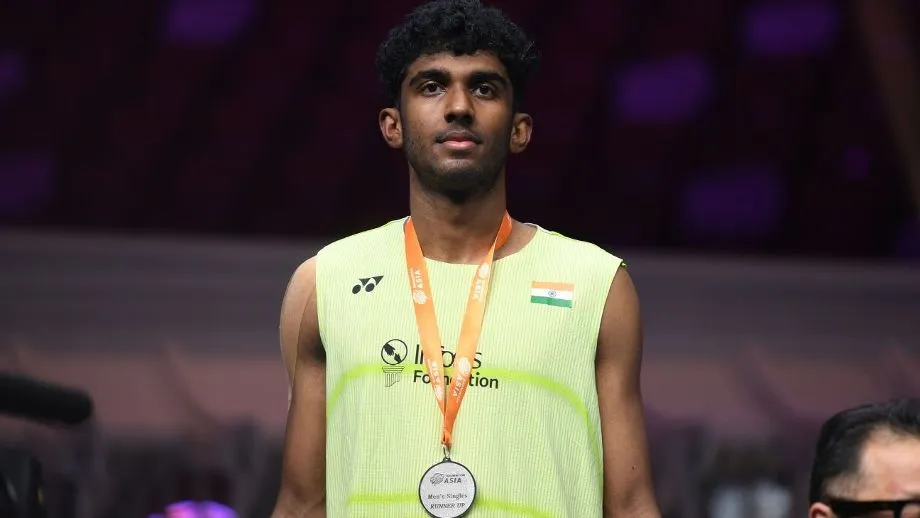
Indian badminton prospect Ayush Shetty has delivered a breakout performance on the BWF World Tour, defeating three top-10 players en route to a runner-up finish. The 20-year-old overcame world No. 1 Kunlavut Vitidsarn, No. 4 Jonatan Christie, and No. 7 Li Shi Feng before falling to reigning world champion Shi Yu Qi in the final. Following an injury-hit start to the season, his performance signals a decisive step forward, reinforcing his potential as a future leader in India’s evolving badminton landscape.
A Defining Run Against Elite Competition
Ayush Shetty’s recent campaign marks a significant inflection point in his professional journey. Over the course of a single week, the young Indian shuttler demonstrated an ability to consistently challenge and defeat some of the sport’s most accomplished players.
Victories against top-ranked opponents are often viewed as the ultimate benchmark of readiness at the elite level. In Shetty’s case, these wins were not isolated upsets but part of a sustained run that highlighted both technical capability and mental resilience.
High-Value Wins and Competitive Maturity
Defeating Kunlavut Vitidsarn, Jonatan Christie, and Li Shi Feng in succession underscores Shetty’s tactical adaptability. Each of these opponents represents a distinct playing style, requiring adjustments in tempo, shot selection, and court positioning.
Such performances suggest that Shetty is evolving beyond raw potential into a player capable of executing match-specific strategies—an essential trait for long-term success on the global circuit.
The Final: A Loss That Strengthens the Narrative
While Shetty ultimately fell short against Shi Yu Qi in the final, the result does little to diminish the broader significance of his campaign. Instead, it reinforces his emergence as a serious contender capable of reaching the latter stages of major tournaments.
Coming after an injury-affected start to the season, the runner-up finish reflects both physical recovery and competitive momentum—key indicators of an athlete’s upward trajectory.
Digital Virality and Brand Expansion
A standout moment during the tournament—a rapid, reflex-driven shot—gained widespread traction on social media, amplifying Shetty’s visibility beyond traditional badminton audiences.
In today’s sports economy, such moments carry commercial value. Enhanced digital engagement can translate into sponsorship opportunities, increased fan following, and stronger personal brand positioning within a competitive marketplace.
Building on a Strong Foundation
Shetty’s rise has been gradual yet deliberate. His first full senior season in 2025, highlighted by a title at the US Open, established a foundation for higher expectations.
This latest performance validates those expectations, suggesting that his development is aligned with the demands of top-tier international badminton. It also reflects the effectiveness of India’s evolving training and support systems.
Implications for Indian Badminton’s Growth
From a broader perspective, Shetty’s success arrives at a critical juncture for Indian badminton. With the sport seeking to expand its global footprint, the emergence of new contenders is essential for sustaining competitive depth.
Notably, his standout performance in a tournament where other Indian players struggled further accentuates his impact, positioning him as a key figure in the next generation of talent.
A Future Defined by Momentum
Ayush Shetty’s runner-up finish should be viewed not as a missed opportunity but as a strategic milestone in his career progression. His ability to compete with—and defeat—top-ranked players signals readiness for sustained success.
As he continues to refine his game and build consistency, this breakthrough week could serve as a catalyst for future titles. For Indian badminton, his ascent represents both immediate promise and long-term strategic value in the global sporting arena.
Comments