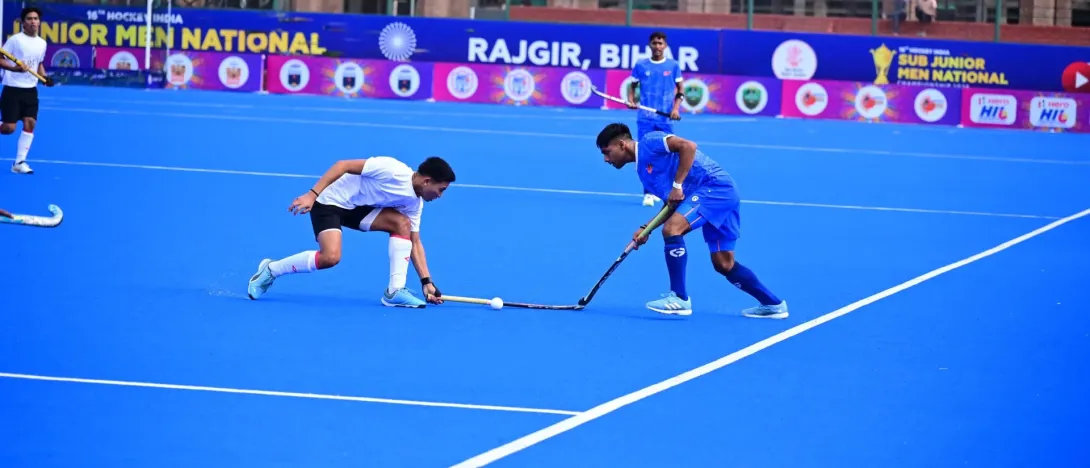
The 16th Hockey India Sub Junior Women National Championship commenced with a series of dominant performances at the Rajgir Sports Complex in Rajgir. Teams such as Hockey Punjab, Hockey Madhya Pradesh, Uttar Pradesh Hockey, and Hockey Jharkhand secured decisive wins in Division A, while Division B saw emphatic victories from Hockey Bengal and Hockey Arunachal. The opening fixtures highlighted both emerging talent and structural disparities, reinforcing the importance of sustained grassroots investment in Indian women’s hockey.
Strong Start in Division A
The opening day fixtures in Division A delivered a mix of tightly contested matches and one-sided encounters. Hockey Punjab began their campaign with a composed 2–0 victory over Hockey Maharashtra in Pool A, demonstrating defensive organization and efficient finishing.
In Pool B, Hockey Jharkhand edged past Dadra & Nagar Haveli and Daman & Diu Hockey with a narrow 1–0 result, underlining the competitive intensity at this level. Meanwhile, Hockey Madhya Pradesh produced the most dominant performance of the day, overwhelming Manipur Hockey 17–1 in Pool C.
Uttar Pradesh Signals Title Intent
Uttar Pradesh Hockey delivered a statement performance in Pool D, defeating Kerala Hockey 10–1. The scale of the victory reflected both attacking depth and tactical execution, positioning the team as a strong contender in the tournament.
Such commanding wins early in the competition often play a crucial role in building momentum and shaping group-stage dynamics.
Division B: Bengal and Arunachal Impress
In Division B, Hockey Bengal recorded a remarkable 18–0 victory against Hockey Gujarat in Pool A, showcasing exceptional attacking prowess. The result stands as one of the most emphatic margins of the opening day.
Hockey Arunachal secured a 5–3 win over Chhattisgarh Hockey in Pool B, offering a more balanced contest that highlighted resilience and competitive spirit from both sides.
Competitive Disparities and Development Gaps
The wide margins observed in several matches point to uneven development levels across participating teams. While some states have established robust training systems, others continue to face challenges in infrastructure and resource allocation.
Addressing these disparities will be essential for ensuring long-term competitiveness and sustainability in Indian women’s hockey.
Investment Trends and Grassroots Growth
The championship reflects the outcomes of increasing investment in grassroots sports, often amounting to several crores (Rs.) across infrastructure, coaching, and talent identification programs. Governing bodies and state associations are prioritizing youth development as a strategic imperative.
Such initiatives are critical in building a pipeline of skilled players capable of competing at national and international levels.
Economic and Regional Impact
Hosting the tournament in Rajgir underscores a broader strategy of promoting sports beyond traditional metropolitan centers. Events of this scale contribute to local economic activity, including hospitality, tourism, and infrastructure utilization.
Additionally, the growing visibility of women’s hockey enhances its commercial appeal, attracting sponsorship and media interest that can further strengthen the sport’s financial ecosystem.
Conclusion: A Promising Beginning with Strategic Implications
The opening day of the championship has set a high benchmark, marked by dominant performances and emerging talent. While disparities in competition remain evident, the overall trajectory signals progress in India’s grassroots hockey framework.
As the tournament unfolds, it will not only determine winners but also shape the future of women’s hockey in the country—reinforcing the need for sustained investment, strategic planning, and inclusive development.
Comments